Showing posts with label Human Rights. Show all posts

Friday, March 24, 2006

The Universality of Human Rights


Following up the 'Asian values' debate at the last PIS meeting, here's a not-so-old essay of mine - minus footnotes, introduction and conclusion - on drawing the line between human rights and culture. This issue happens to be getting the media glare right now, with the impending execution of an Afghan citizen for converting from Islam to Christianity.

I'll try to follow this up with something more specific on 'Asian values', assuming I have any energy left to think after homework, job applications and LSS tutes.

Cross-posted at the club blog.

______________________________________________________

Human rights must have legitimacy if they are to be realised within a given community. The widespread perception in Muslim countries that human rights are ‘un-Islamic’ or a tool of western imperialism, for example, makes it difficult for governments to implement human right or for rights advocates to gain social and political traction. In developed states like the US, opposition to judicial enforcement of economic and social rights stems more from perceptions that they are not bona fide ‘rights’ than from persuasive separation-of-powers arguments. Attempts to give human rights an objective basis, for instance by linking them to economic development, have met little success; implementation of human rights depends on a cultural choice by the community in question, a choice that can only spring from cultural legitimacy.

The basic problem faced by the global human rights movement is that the very concept of human rights, defined as inalienable claims by an abstract individual upon society, lacks legitimacy outside the western world. If one attempts to ground human rights in religion or moral philosophy, they appear as a western cultural construct. Even accepting that numerous belief systems recognise the inherent human dignity on which human rights are founded, many manifest practices that are inconsistent with ‘international’ human rights norms; certain principles in Islamic jurisprudence, for example, conflict directly with the rights to freedom of belief, freedom of speech and equality before the law. A strong argument can be made that other key concepts underpinning human rights – the individual’s autonomy from society and the cosmos, for instance – are specifically western cultural developments. As such, their introduction into non-western societies presupposes that these societies are either culturally deficient or on an evolutionary path that will turn them into facsimiles of the contemporary west.

Nor have positivist approaches to human rights given non-western peoples the sense of cultural ownership that grounds legitimacy. The core of international human rights, expressed in the Universal Declaration, was articulated by western states in the context of the ideological struggle with communism. On an ongoing basis, Western states are perceived to serve vested commercial interests by promoting civil and political rights over economic and social ones, abandoning even the former when inconvenient (take Australia’s reservations to the ICCPR regarding federal implementation and juvenile detention). Non-western governments stand accused of using communitarian conceptions of human rights to justify internal repression. In this context, the non-western world at large has unsurprisingly developed a cynical understanding of human rights.

Yet despite the rhetoric of cultural distinctiveness from their elites, non-western societies are taking an evolutionary path similar in many respects to that of the west: industrialising, evolving powerful bureaucracies, developing market economies. In this changing social context, human rights are necessary to shield ‘authentic human life’ – whatever cultural expression that life may take – from the corrosive effects of modernity. Freedom of speech and association, for example, may be needed to protect traditional social structures or cultural practices from exploitative employers, corrupt bureaucrats and callous state policies.

Critiques of human rights as exclusively ‘western’ also employ an excessively static notion of culture. Muslim rights advocates have argued that the Shari’a provisions referenced above are a historically contingent interpretation of Islamic texts, which should be reinterpreted consistently with contemporary conditions. Torture and poverty were once considered legitimate by virtually all societies (including western ones) but are now widely rejected, at least in theory. These are instances of a global cultural evolution towards recognition that certain practices and conditions diminish human personality in any cultural context. Critics of the universal rights discourse correctly assert that ‘personality’ is culturally defined, but miss the point that it attaches to a universal ‘individual’ who is the subject of human rights. If the individual’s integrity is compromised, for instance through torture or poverty, personality cannot be fully realised. Pace Douzinas, the ‘human’ in human rights signifies a physical and mental core on which all cultures operate.

Human rights thus have a universal moral basis, notwithstanding their initial conception in the west, and as such are universally applicable. The global human rights machinery serves a legitimate role in monitoring adherence to human rights within all states, including their western progenitors; consider the Human Rights Committee’s (HRC’s) declaration of a US reservation to ICCPR subordinating that treaty to the US constitution as invalid, or the UN High Commissioner’s finding in 2002 that Australia had breached the ICCPR and the ICESCR. However, the precise content and means of enforcement of human rights must correspond to social organisation and conditions, which differ between nations and cultures. The right to freedom from arbitrary interference with privacy or family, for instance, may need to countenance traditional forms of community supervision and authority (for example the role of village elders in regulating social relationships).

Implementation of human rights should therefore take place as locally as practicable, for instance through national or regional human rights commissions, rather than via international treaty mechanisms such as the HRC’s individual complaints mechanism. Localised implementation avoids the charge of western cultural imposition, and allows rights to become ‘foundations for actions and policy’ rather than meaningless abstractions. It is only through such ‘concretisation in the [local] context’ that human rights will acquire the legitimacy needed to take root in a particular community.


Wednesday, January 11, 2006

The Torture Question


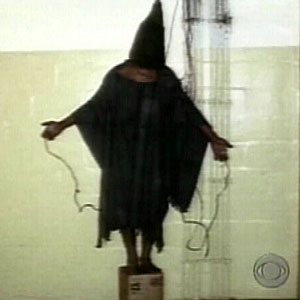
When the Abu Ghraib scandal broke (April/May 2004), I happened to be taking a subject in American politics. I recall my lecturer remarking that in the chessgame of the War on Terror, prisoner abuse was an incredibly stupid move on the US government's part, and that those photos would bedevil US foreign policy for decades to come. He's right on both counts, but he could have taken the point further. America's peeling back of interrogation constraints was indeed stupid, but it was also meticulously planned by intelligent people.

Any claim that Abu Ghraib was an isolated incident - still the Pentagon and White House line - can be thrown on the trashheap of right-wing denial. Aside from the blooming array of secondary books on the subject, a paper trail of the Bush administration's orchestrated rollback of anti-torture provisions in international and US domestic law can be found in The Torture Papers. Or if you're lazy, you can watch Frontline's The Torture Question, which screened on ABC tonight and prodded me into writing this post. PBS being America's friendly taxpayer-funded channel, the entire program can be found here, conveniently broken into 10 minute chunks.

Like all good documentaries, The Torture Question complements the printed word by putting you in the grit of the action. It includes interviews with GTMO prison bosses, Janis Karpinski and the first (ex) US military interrogator to go public about what's happening. What comes through most - apart from the repulsiveness of the acts themselves - is the collusion at every level of the system, notwithstanding that once the scandal broke the grunts who'd got their hands dirty were hung out to dry by their superiors. The general tone recalled a piece I once read about the response of German soldiers asked why they committed atrocities on the Eastern Front: essentially, "everyone else was doing it".

1st ANONYMOUS INTERVIEWEE: I mean, you had a lot of rank there. You know, we're not talking about just a few officers and a lot of soldiers. There was a lot of officers, high-ranking officers, a lot of senior NCOs all over the place. And none of them had a problem, seemingly, with what was going on.

While it wears its sympathies on its sleeve, The Torture Question does give airtime to those who say the Geneva Conventions should not apply in the War On Terror, because the enemy cannot be distinguished. But this is precisely why they should apply. The fact that America was attacked on September 11 is used as a smokescreen to hide the fact that the US is defining the targets of its response. Labelling the inmates of Abu Ghraib or Camp X-Ray 'terrorists' sets up a clasic straw man - for the purposes of principled debate we do not know that they are terrorists, even if in practice many fall somewhere along a reasonable spectrum of US security threats.

When we get to the essence of torture, however, the guilt of the victim is irrelevant. As put by John McCain - one of those rare pollies whose integrity has survived Capitol Hill - this isn't about who they are, it's about who we are. Torture is about asserting power by destroying another human being; it is not a utilitarian device that can be switched on and off as circumstances require. The word is derived from the Latin verb "to twist"; the image is of the rack, still common in late-18th century Europe, that America's founding fathers had in mind when they wrote article VIII of the Bill of Rights.

Rather than going on in this vein I'll direct readers to the Victorian Foundation for Survivors of Torture, whose director puts the case more eloquently than I ever could. The only insight I'll add draws on my reading into why Europe made the leap into the modern world, where other larger, wealthier and more technically advanced societies failed. If there's one cultural reason for the West's success it's because in Europe, for all its Bastilles and witchhunts, one couldn't be stretched out and bastinadoed to death at a despot's whim. That is exactly what happened, in principle if not literally, at Abu Ghraib. It continues to happen across the global detention empire run by the CIA and the US military; now outside it, too, if The Torture Question's testimony is accurate.

Spc. ANTHONY LAGOURANIS: Part of it is, they were trying to get information, but part of it is also just pure sadism. You just kept wanting to push and push and push and see how far you could go. It's natural for people to reach an intense level of frustration when you're sitting there with somebody that you feel you have total control over and total power over, and you can't get him to do what you want. And that you do that all day, every day. And at some point, you want to start raising the stakes.


Thursday, November 24, 2005

Death in the Lion City

Update 26/11/05

With less than a week to Nguyen's execution, the pro-deathers now have their own blog, HangVan. Strangely enough, it uses the same template as the Singapore anti-death penalty campaign blog, Changi-Gallow, which was set up a month ago in response to Nguyen's case.

"If coincidences are just coincidences, why do they feel so contrived?"
_____________________________________________


With exams over, I once more have time for the important things in life, like blogging. And seeing my brother off to Japan, where he's language-cramming till February. You never know who you'll meet at the airport; on the way out I ran into our local Attorney-General Rob Hulls, on his way to Singapore to make a last appeal in the case of Nguyen Tuong Van.

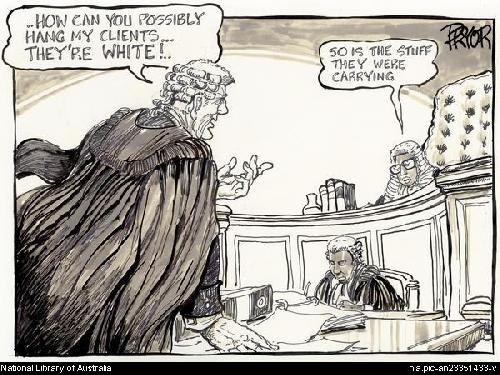
For those who don't live in Australia (or do, but under a rock), Nguyen is the young Melburnian who hangs in Changi prison for heroin trafficking in a week's time. When the media picked up his case a few months back, I didn't expect a rerun of the Schappelle Corby affair. Nguyen was unambiguously a drug mule, not to mention Vietnamese and male. I remember remarking to a friend on the comparative lack of clamour over Nguyen's plight, and speculating that Australian perceptions of Singapore as a 'first world' nation and of Indonesia as a 'third world' one were reflected in the credibility given their respective legal systems.


"Our Schapelle?" "Our Van?"

As if to prove me wrong, those first trickles of publicity have turned into a flood. For weeks now the Australian media has editorialised from right and left against the mandatory death penalty's barbarity, the more so when applied by a 'developed' country. The shadow foreign minister said on national television that Singapore has treated Australia with contempt over this matter, which is direct as diplomats get. Even the normally unflappable PM was visibly angry upon learning of Nguyen's execution date from Lasry rather than Lee Hsien Loong, with whom Howard had just appealed for clemency in one-on-one talks in Busan. Newspaper letter pages and the blogosphere have resounded with boycott threats against SIA and Optus (owned by Singtel). Less choleric but equally public has been the tracing hands campaign mobilised by Nguyen's supporters, whose cutout paper hands blanketed the lawns outside the State Library last Friday.

The response from Singaporean columnists and bloggers has been less widespread, though what's out there is aggressive enough, wheeling out the old carts of Western cultural imperialism and racism. Certainly much of the Australian public comment has been turning ugly, with eminents like Gough Whitlam now railing against that "Chinese rogue port city." Even the Nguyen campaign blog has appealed against the "belligerent, jingoistic tone that local press coverage and letters have taken in the past few days," as this is hardly likely to change powerful minds in Singapore where a bipartisan resolution of the Australian parliament failed. If the fatal date hadn't already been set it might even lead to a fasttracking of the execution, as happened with the Barlow and Chambers case in Malaysia two decades ago. When the discourse is studded with words like 'barbaric' and 'primitive', it constantly runs the risk of slipping across that hazy boundary into denigration of the brown man and his law.


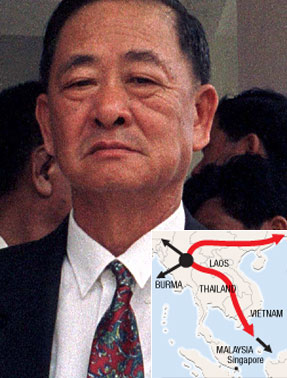
But much of the Singaporean comment has also been knee-jerk nationalism: "our country, our right to kill him," with little debate on the merits of a mandatory death sentence for trafficking a few hundred grams of narcotics. What argument there is tends to feature mantra-like recitation of the 26,000 heroin shots Nguyen was carrying (which clearly equals 26,000 innocent deaths) and uncritical defence of the death penalty's efficacy as a deterrant, without examining whether this is borne out in practice. The flipside of this general failure to question government policy is the turning of media heat on dissenters like opposition leader Chee Soon Juan, who's voiced his opinions in the Australian media after the local press failed to carry them. Nor is there much talk of Singapore's financial links with narcostate Burma, which include direct investment in Southeast Asia's most notorious heroin lord, and the ethical implications for a policy of executing one-off couriers like Nguyen.

Lo Hsing Han, Sino-Burmese drug baron and beneficiary of Singapore's public largesse

Nguyen's case has become a platform for the parlous state of political discourse and civil society in Singapore. Not only is it a veritable running column at Singabloodypore and other internal critics of the Lion City, it has galvanised the local anti-death penalty movement (which now has its own blog) and has been taken up by the NGO-based Asian Human Rights Commission. There is growing international consensus, including several decisions of the Privy Council (Singapore's final court of appeal until 1994), that the death penalty constitutes "cruel and inhuman punishment" under customary international human rights law. How long Singapore's government can continue to respond that the death penalty is not a human rights issue is anyone's guess, but the trends suggest that its old two-track strategy of refusing to sign treaties like the ICCPR while smothering debate at home may not work much longer for a nation with the 29th highest per capita GDP in the world.

For me, the Van Nguyen affair has turned up several personal dimensions. In high school I gave a laudatory presentation on Singapore's model success story, which in retrospect was a tad naive in some departments. I spent the better part of my last summer holiday in Singapore (much of it at NUS proscrastinating on a research paper). As for Nguyen himself, we share the experience of growing up in a first-generation Asian migrant family in Glen Waverley. My old classmate Bronwyn Lew has been one of the faces of the campaign for Nguyen's life. And then, of course, there was Rob Hulls in the airport on Wednesday. As I left the media scrumming for pictures of Hulls having his luggage weighed, I had to reflect that this world really is just one step from the sublime to the ridiculous.