Showing posts with label World politics. Show all posts

Sunday, September 17, 2006

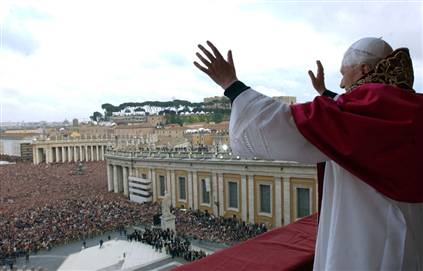
Pontifex Tactlessness


The latest uproar over a perceived slight to Islam isn't going quietly into the night. One week on it's spawned its own wikipedia entry, a slew of rants throughout the wingnut blogosphere and obssessive mainstream media coverage. A speedy resolution hasn't been helped by Muslims round the the world again deciding that the appropriate response to barbs about their faith's peacefulness is to bomb churches and issue death threats.

Nor by the fact that this time the offending observations came not from a Danish newspaper but rather the head of the Catholic Church, albeit wrapped in a theology lecture (full text here). It's unfortunate that the Pope couldn't make a point about faith and reason without a reference to jihad. And he couldn't even do that without quoting that bosom buddy of medieval Catholicism, the Byzantine emperor -

Naturally the emperor also knew the instructions, developed later and recorded in the Qur'an, concerning holy war... [he] addresses his interlocutor with a startling brusqueness on the central question about the relationship between religion and violence in general, saying: "Show me just what Mohammed brought that was new, and there you will find things only evil and inhuman, such as his command to spread by the sword the faith he preached". The emperor, after having expressed himself so forcefully, goes on to explain in detail the reasons why spreading the faith through violence is something unreasonable.

The decisive statement in this argument against violent conversion is this: not to act in accordance with reason is contrary to God's nature... But for Muslim teaching, God is absolutely transcendent. His will is not bound up with any of our categories, even that of rationality.

This passage amounts to the following claims: a) spreading faith through violence is irrational; b) Islam teaches violent conversion; c) Islam teaches an irrational approach to faith. The Pope's speech has to be read as tacit endorsement of all these propositions. You don't use quotes to illustrate a point unless you believe the quotes to be true in substance, even if you find their expression 'startlingly brusque'. And you can't seal yourself off from controversial assertions by putting them in the mouths of medieval monarchs, or by protesting that the statements were tangential to your main point.

The issue here is not whether the claims about Islam are true. The Pope is an official figure and as such doesn't have the freedom that he enjoyed as Joseph Ratzinger, Professor of Theology, to comment on the teachings of other religions. He has the right to say what he wants, but also responsibility for the consequences, especially when pointed observations about the religion in question have a history of generating violence. This isn't 'political correctness', it's political common sense. The pontiff can no more wash his hands of this than politicians who accuse foreigners of stealing jobs can divorce themselves from a xenophobic backlash in the electorate.

Pope Benedict would have done better citing the example rather than the ideas of the said Byzantine emperor. Manuel II may have argued that Islam is disposed to violence, but he and his Muslim interlocutor were debating the issue with words rather than swords (not that Manuel had much choice, at a time when the Turks were tightening the noose round his beleagured 'empire'). One might have expected some progress on interfaith relations over the intervening six centuries. Instead they seem to be heading back to an era captured by the opening scene of Alan Savage's Ottoman, in which Manuel II's son is presented with the severed, uncircumcised penis of a Hungarian knight as proof of the fate of the last crusade.


Postscript


For firebreathing secularists, the natural response to this sort of thing is a pox-on-both-your-houses. I stick by my angle: the trouble isn't with religion per se, but with trying simultaneously to be a theologian and a politician.


Friday, October 07, 2005

The End of the UN?


With killer hurricanes, terrorist bombings and soaring oil prices in the news, the recent UN World Summit hasn't been able to compete - the more so since it appeared to accomplish nothing. Far from being business as usual for the UN, however, the failure to push through substantial reform may have long-term consequences that will leave Katrina as a footnote to history. According to Assistant Secretary-General Ramesh Thakur, who gave a lecture at Melbourne Uni before the World Summit, an outcome such as last month's means the beginning of the end for the United Nations. "The Iraq war we can survive," said Thakur, but not a failure to grasp what he described as the UN's last chance for reform, especially of the Security Council. If he's right, the UN is in the process of becoming George Bush's one accurate prediction: an irrelevant organisation, fading from history's stage with barely a whimper.

From the media commentary, you'd think anyone right of centre believes this to be a good outcome, and one long overdue. The coverage of the World Summit and the overshadowing oil-for-food scandal has been a metaphor for the UN's fate to be judged by its failures alone. People rarely reflect that the relatively benign functioning of the international system since 1945, despite the tensions of bipolarity, the quadrupling of nation-states and (more recently) unchecked US power, may have something to do with an overarching global institution. The UN is a cornerstone of the 'grand strategic bargain' on which the current world order was built - a bargain underpinned by the international rule of law and participatory decision-making, not limitless military power. Consider this recent assessment by the Rand Corporation, that quintessential product of the US military-industrial complex -

The cost of UN nation-building tends to look quite modest compared with the cost of larger and more demanding U.S.-led operations. At present, the United States is spending some $4.5 billion per month to support its military operations in Iraq. This is more than the United Nations spends to run all 17 of its current peacekeeping missions for a year. This is not to suggest that the United Nations could perform the U.S. mission in Iraq more cheaply, or perform it at all. It is to underline that there are 17 other places where the United States will probably not have to intervene because UN troops are doing so at a tiny fraction of the cost of U.S.-led operations.

Since 1945 the UN has conducted 56 peacekeeping operations, most of which have been success stories. It has provided the coordinating machinery for bodies such as the IAEA and WTO, not to mention agencies and programmes of its own that promote global cultural heritage and quality of life, such as UNESCO, UNICEF, the WHO and the World Food Programme. The UN has served as a vehicle for advancing the global human rights movement and the international rule of law, sponsoring treaties like the ICCPR and the Torture Convention, evolving a vast reporting network for worldwide human rights abuses and mandating ad hoc tribunals to punish war crimes and crimes against humanity. In short the UN has provided a measure of international governance, however limited, a role that the events of the past four years have shown individual states, no matter how powerful, to be incapable of fulfilling. It's a matter of horses for courses, as the generation of US policymakers who created the United Nations understood.

When states attempt to work through the UN properly - as the first Bush administration did in 1990-1 - the organisation functions more or less as its architects intended. When they starve the UN of funds, prostitute its processes to national foreign policy aims and block necessary structural reform, it obviously becomes dysfunctional. Washington's failure to support the bid for a Security Council seat by Japan -its closest ally bar Britain and Australia, and certainly its most important one - is the latest proof that the UN's core problem is not corrupt bureaucracies, but the self-interest of member states and in particular that of the Security Council's permanent five members. If states treat the UN as a forum for zero-sum competition, the body can't effectively promote the international public interest.

That the UN badly needs systemic reform is not in dispute; the Secretary-General himself has said as much, in a report released in March as a reform blueprint for the World Summit. For just one example, take Annan's proposal to shift the UN's policing of human rights from the state-dominated Commission on Human Rights to the High Commissioner for Human Rights, a bureaucratic office which has produced far better outcomes in recent years than the CHR. It will prove a tragedy of historic proportions if, at a point when the UN's leadership is finally showing the mettle to deal with its internal problems, it is crucified on Koffi Annan's personal failings and the Bush administration's ideological agenda. The UN is the fulcrum of the current international system, which aspires to transcend naked power politics; the neocons attack the UN because they want to dismantle that system in its entirety, in favour of a world order explicitly based on US military power, a project whose sun is already setting in Iraq. The UN may have accumulated a chequered record over six decades, but it's preferable to the results that four years of American unilateralism has delivered so far.