Showing posts with label Asia-Pacific politics. Show all posts

Monday, July 10, 2006

The War That Never Ended


Like the Chen Yonglin scandal, April's row over MIT's online publishing of century-old woodblock prints was a localised affair. But they make for an illuminating comparison.

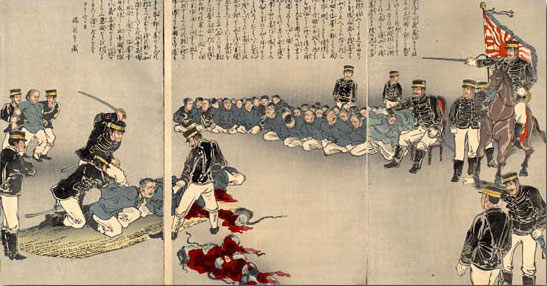
The Massachusetts Institute of Technology has taken down a history course Web page after a 19th century wood-print image of Japanese soldiers beheading Chinese prisoners sparked complaints from Chinese students and led to an apology from one of the course's professors. The "Visualizing Cultures" course, which uses images from the Sino-Japanese War of 1894-1895, was spotlighted Sunday on MIT's home page. It was pulled late Tuesday afternoon, and the school hosted a forum Wednesday for students, particularly those in MIT's Chinese community, to voice concerns. (AP)

John Dower took full responsibility for selecting the images and writing the commentary, explaining that to present propaganda images for educational use was not to condone their message... But the students could not grasp this point. Blinded by passion, they shouted that Dower and Miyagawa had been insensitive to the tremendous suffering of the Chinese people at the hands of Japanese militarism. One student undertook to edify Prof. Dower on the finer points of Japanese history by proudly presenting him with a copy of a popular book on the Nanjing massacre! Written demands circulated at the meeting included shutting down the site permanently, demands that MIT officially apologize to the offended “Chinese community,” and cancellation of academic workshops related to the site. (Perdue)

By this point an online hate campaign was under way against the two history professors involved, one of whom had the misfortune to be of Japanese ancestry. The MIT establishment was mystified as to where this outrage was coming from; it's not like images of graphic violence are hard to find on the internet, even those involving Japanese soldiers beheading Chinese victims. One group at the heart of the controversy sought to elaborate -

The MIT Chinese Student and Scholar Association, in a letter to MIT President Susan Hockfield, called for "proper historical context" at the top of the page, and asked for a posted warning that the images are graphic and racist.

"We do understand the historical significance of these wood prints, and respect the authors' academic freedom to pursue this study," the letter stated. "However, we are appalled at the lack of accessible explanations and the proper historical context that ought to accompany these images."
(AP)

So what was the 'historical context' provided on the original webpage?

Dower’s text describes one such print, entitled “Illustration of the Decapitation of Violent Chinese Soldiers,” which depicted Japanese soldiers executing helpless Chinese prisoners of war, as “an unusually frightful scene.” ... He continues, “Even today, over a century later, this contempt remains shocking. Simply as racial stereotyping alone, it was as disdainful of the Chinese as anything that can be found in anti-“Oriental” racism in the United States and Europe at the time – as if the process of “Westernization” had entailed, for Japanese, adopting the white man’s imagery while excluding themselves from it. This poisonous seed, already planted in violence in 1894-95, would burst into full atrocious flower four decades later, when the emperor’s soldiers and sailors once again launched war against China.” (Perdue)
Most would read this as a mundane condemnation of Japanese imperialism, as well as context-setting for subsequent East Asian history. But evidently a great number of Chinese people read it as a national insult and dismissal of China's historical grievances. Perhaps it was the use of the adjective 'violent' for the hapless Chinese soldiers, thoughthe description might be justified given that Chinese soldiers did commit atrocities in the 1894-5 war. But had that word been absent, chances are the reaction would have been the same - on trend.

Expressing political positions through violence (verbal or otherwise) is hardly unique to Chinese people; a good many freedom-loving, rule-of-law-respecting Americans have sent death threats to everyone from the Dixie Chicks to justices of the Supreme Court. But given the series of riots touched off over the past eight years by the Belgrade embassy bombing, soccer defeats by Japan and the Japanese government's approval of questionable history textbooks, a foreign observer might feel justified in making systemic conclusions about the 'New China'. Particularly if they're aware of unedifying local incidents like this one and Chen Yonglin's reception at Melbourne University last year, which occurred not merely outside China but within western universities, the institutional embodiment of free expression.

The last thing China needs is an image as a country of nationalist psychotics, who use past wrongs as an excuse to flout norms of civilised behaviour. Indeed the 'China Threat' lobby, which has long cast the Beijing regime as antisocial, has switched to painting the whole of Chinese society in these terms - a sort of high-tech Nazi Germany with a billion people. Still, it doesn't seem too much to expect respect from Chinese nationals for free speech, at least in other countries. It's not a hard concept - no one is obliged to tailor published material to others' sensitivities, short of hate speech or slander. And people express disagreement through reason, not insult and intimidation.

This should be doubly so in the case of academic enquiry. Stumbling across the MIT affair on China History Forum brought to mind an essay I wrote for a Japanese history subject a few years back on the 1894-5 war, including analysis of these same woodblock prints. Extracts follow -

'... foreigners were looking at the war not as an ordinary (i.e. European) great power conflict, but as a contest between two Oriental peoples. Japan's achievement was seen in contrast with the staggering corruption and incompetence of the Chinese 'war effort', if it can be called such. Japanese professionalism was cast in glaring profile by the benighted state of the Chinese soldiery, which in the absence of proper training and armament relied on superstitions such as carrying lucky chickens into battle or eating ground tiger bone to induce courage. Mutilation of prisoners, pillage of the civilian population and medieval practices like offering rewards for Japanese heas completed the image of a confrontation between modern civilisation and barbarity

'[in] contemporary woodblock prints... with their western uniforms and equipage, dignified poise and orderly dispositions, the Japanese soldiers in these pictures personify modernity. By contrast the Chinese, with their anachronistic display of colours and polearms, appear in a continuous state of chaos and defeat. The prints illustrate the triumph of modern substance over antiquated display...'
My essay was for a Japanese history subject, so it's written from a Japanese perspective. I felt no need to qualify it by listing Japanese atrocities against the Chinese people, by explaining that the Qing armies' dismal performance was not typical of Chinese history, by acknowledging that Japan borrowed its writing system, architecture and form of government from China etc. Yet had this been on the MIT website, I might have received the same treatment as Professors Dower and Miyawaga. Indeed being Chinese, I could have expected additional epithets revolving around 'race traitor'.

Remembrance and justice are one thing, hatred is another. These outbursts don't help China's civil society, Japanese attitudes or East Asia's political environment, which seems to be getting more corrosive by the year. Sometimes it seems to students of the region that nothing has really changed since Japan smashed the old order a hundred-plus years ago, failing to put something constructive in its place. And where better to reflect on that momentous war than MIT's online exhibition, which remains up and running - with a few modifications.


Non sequitur

The scheme by Japan's foreign minister to rope foreign ambassadors into a World War II commemoration has fallen through, apparently after Taro Aso realised they weren't going to grace an official function led by a man who refuses to acknowledge that his daddy worked Allied POWs to death.

And Greg Sheridan, who nearly self-immolated over the AWB affair, has utterly redeemed himself in my eyes with this piece on that other fractious Asian relationship (Australia-Indonesia). Not one line in that article I disagree with.

Tuesday, May 30, 2006

The Taiwan Strait War, 2013


Fast-forward to June, 2013. Consider the following sequence of events -


The Republic of China's president, a DPP independence hawk with a legislative majority, announces his intention to seek a constitutional amendment changing the island's name to the Republic of Taiwan. Despite PRC warnings, the US government's response is watered down to 'non-support', in the face of overwhelming sympathy for Taiwan from Congress and the American public.

Amidst mounting rhetoric from Beijing, two US carrier battlegroups are despatched to the waters east of Taiwan. The ROC government unveils its constitutional changes, which - in another unpleasant surprise for Washington - exclude any part of mainland China from the new republic, amounting to irrevocable rejection of the 'One China' principle. The PLA is mobilised.

With the American media howling 'appeasement', the US president reiterates that an attack on Taiwan is a matter of grave concern for the United States. All Washington's regional allies declare neutrality; Japan and South Korea even deny the US use of military bases on their soil. China's central bank floods the market with US treasuries, sending Wall Street and the US dollar into tailspin. Congress passes a landslide resolution pledging to defend Taiwan.

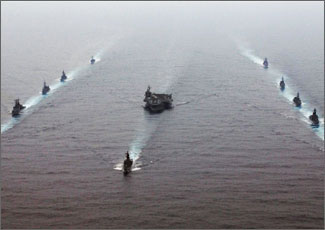
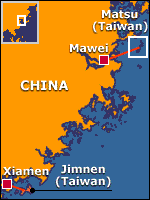
The PLA occupies Jinmen and Matsu, and in response the two US carriers enter the Strait. China announces a blockade and fires a hundred missiles into Taiwan; the ROC airforce hits back at mainland targets. The penny drops when US and Chinese forces engage. Who shot first remains in doubt, but the Chinese simultaneously launch an electronic warfare offensive, cancelling the traditional US information dominance of the battlefield.

A US carrier goes to the bottom, with almost all hands. The American public cries for blood and US planes join the ROC airforce to plaster targets along China's southeast coast. Both Washington and Beijing put their strategic nuclear forces on maximum alert. Urged to send the B2's against Beijing and Shanghai, the US president blinks at armageddon and calls his Chinese counterpart, who's also getting cold feet. China lifts the blockade and withdraws its forces on a number of conditions, including the resignation of Taiwan's president and the opening of reunification talks. Faced with a threatened US withdrawal, Taipei buckles.

In the aftermath, the US severs diplomatic ties with China and slaps a total ban on commercial intercourse. The US and the world economy suffer, but not as much as China, which for a while looks ready to descend into chaos. But the Communist Party clings on and settles in for a new cold war across the Pacific, which three decades later is still going strong. After a decade of talks, Taiwan joins China in a loose confederation.


At this point I should confess that this cheerful scenario isn't my own work, but a summary of the second chapter in America's Coming War with China. It does happen to tally almost exactly with an essay I wrote last year on the ominous trends in the 'Taiwan problem'. Unless some serious political lifting is done, we're more likely than not to have a war in the Strait within the next ten years.

That lifting needs to come from both sides of the Pacific. At a general level the whole power structure of the Asia-Pacific needs a makeover, as I argued a while back on this blog, if Sino-US conflict is to be averted. On Taiwan specifically, the US needs to junk 'strategic ambiguity' in favour of a tougher stance towards the governments on both sides of the Strait. The key elements of the above scenario are Beijing's readiness to attack Taiwan upon a decisive bid for independence, and Washington's failure to preempt such a bid or squash it the moment it happens (as happened to Taipei's nuclear program). A clearer US commitment to the status quo wouldn't guarantee against this situation, but it would help.

It's high time that someone with foreign policy credentials spotlighted this issue, in the form of an accessible read. So kudos to America's Coming War With China, even if in other bits it shows up the incapacity of Western commentators to get basic China facts straight. Memo to Mr. Carpenter: it wasn't the Ming dynasty which occupied Taiwan in 1661.


The BBC reports on Taiwan's new acquisition - 'Jimnen', not to be confused with Jinmen

Scoff at this scenario if you like, but recall that September 11 was unthinkable before it happened. (Whether some people foresaw the use of passenger jets as weapons of terrorism is besides the point). By contrast, analysts have been warning for the better part of a decade - Carpenter's book was published in 2001 - that the 'Taiwan problem' is heading towards a violent resolution. We even had a dress rehearsal in the form of the 1996 Straits Crisis, which played out along similar lines to Carpenter's scenario. Since then the PRC's military position has strengthened, vis-a-vis the US and especially the Republic of China, which has elected a president who rejects the basic principle underpinning Beijing's approach to the problem.

And yet we're sill waiting for some creative thinking in Washington about management of the Taiwan issue and relations with the PRC more generally. Instead we've got a 'China Threat' literary industry, long on hysteria and short on knowledge of contemporary China, let alone the country's history and long-term prospects. At the official level we now have a US strategy for 'full-spectrum dominance' and the cleansing of terrorism from the earth, into which China is expected to fit meekly. The issue of Taiwan's independence gets once sentence, and it doesn't offer concessions to Beijing.

Next to the potential consequences of this war, the threat posed by Islamic extremism pales into insignificance.

Friday, May 26, 2006

The Forgotten POWs


The recent visit by Japan's Foreign Minister to Australia generated some embarrassing publicity about his family company's wartime 'employment' of Australian POWs. Taro Aso now plans to pay his respects at the shrine commemorating Allied prisoners who died in labour camps within Japan. It's certainly a change in gear from his visits to the infamous Yasukuni shrine, whose relics include an engine from the Thai-Burma railroad, the construction of which cost the lives of 2,815 Australians.

A cynic might say that Aso - one of the frontrunners for the Prime Minister's job when Koizumi vacates it this year - is trying to distance himself from a career-full of gratuitous comments on Japan's expansionist past. Perhaps the time spent hobnobbing with Alexander Downer, whose father was interned at Changi, has reminded Aso that China and South Korea aren't the only countries Japan has historical issues with. And perhaps the rise of Chinese power has something to do with Japan's Foreign Minister visiting a temple dedicated to the victims rather than the agents of Japanese imperialism, with the ambassadors of Tokyo's allies invited to observe the change of heart. There's no sign that Aso Cement will join the list of German and Japanese companies - notably Siemens and Mitsubishi - fighting lawsuits over their use of slave labour during World War Two.

At least the poor souls whose ashes rest within the Juganji Temple are getting their smidgen of honour. The final tragedy of World War Two was how the memory of so many victims was buried in the new politics of the Cold War, a problem compounded by countries' selectivity in honouring their wartime dead. So let's not begrudge this moment of recognition for men who perished toiling for a worthless cause, forgotten then and forgotten now.

Thursday, December 01, 2005

Scrapbook: Dead Man Walking


It could be a poster for "Legend of Sleepy Hollow II."

Or it could be irresponsible editing from The Age, which juxtaposed the image with today's letter from Joseph Koh (Singapore's High Commissioner in Australia) defending the decision to execute Nguyen. Blurring the issue into a vendetta against the Lee dynasty doesn't help either Nguyen or bilateral relations. Most Singaporeans I've asked think Lee Hsien Loong is fit for his job, notwithstanding that he's there on birth rather than merit per se. Bred to rule, I suppose.

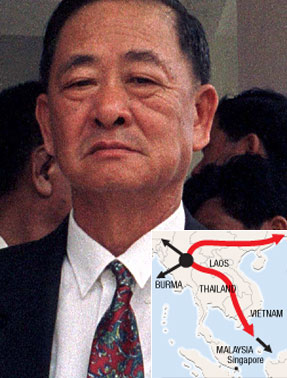
The only thing new in Koh's letter was his response to allegations that Singapore connives with Burmese drug lords. He doesn't provide many specifics, which one would expect given the evidence linking the Singapore Government Investment Corp. and Lo Hsing Han, detailed in the article I linked in my last post and in this report from the Free Burma Coalition. Extract follows -

At a news conference in February (1997), Robert Gelbard, then Assistant Secretary of State for the Bureau of International Narcotics and Law Enforcement Affairs said "Drug traffickers have become the leading investors in Burma's new market economy and leading lights in Burma's new political order. Since 1988, over half of (investment) from Singapore has been tied to the family of narco-trafficker Lo Hsing Han." Singapore has never responded to the US criticism.

To be fair, the fund tying the SGIC and Lo was liquidated in 1997, and I haven't found anything about subsequent Singaporean public investment in dubious Burmese concerns, though a recent US State Department report suggests that the country remains an international money laundering hub (alongside Japan, the UK, the US...).

Thursday, November 24, 2005

Death in the Lion City

Update 26/11/05

With less than a week to Nguyen's execution, the pro-deathers now have their own blog, HangVan. Strangely enough, it uses the same template as the Singapore anti-death penalty campaign blog, Changi-Gallow, which was set up a month ago in response to Nguyen's case.

"If coincidences are just coincidences, why do they feel so contrived?"
_____________________________________________


With exams over, I once more have time for the important things in life, like blogging. And seeing my brother off to Japan, where he's language-cramming till February. You never know who you'll meet at the airport; on the way out I ran into our local Attorney-General Rob Hulls, on his way to Singapore to make a last appeal in the case of Nguyen Tuong Van.

For those who don't live in Australia (or do, but under a rock), Nguyen is the young Melburnian who hangs in Changi prison for heroin trafficking in a week's time. When the media picked up his case a few months back, I didn't expect a rerun of the Schappelle Corby affair. Nguyen was unambiguously a drug mule, not to mention Vietnamese and male. I remember remarking to a friend on the comparative lack of clamour over Nguyen's plight, and speculating that Australian perceptions of Singapore as a 'first world' nation and of Indonesia as a 'third world' one were reflected in the credibility given their respective legal systems.


"Our Schapelle?" "Our Van?"

As if to prove me wrong, those first trickles of publicity have turned into a flood. For weeks now the Australian media has editorialised from right and left against the mandatory death penalty's barbarity, the more so when applied by a 'developed' country. The shadow foreign minister said on national television that Singapore has treated Australia with contempt over this matter, which is direct as diplomats get. Even the normally unflappable PM was visibly angry upon learning of Nguyen's execution date from Lasry rather than Lee Hsien Loong, with whom Howard had just appealed for clemency in one-on-one talks in Busan. Newspaper letter pages and the blogosphere have resounded with boycott threats against SIA and Optus (owned by Singtel). Less choleric but equally public has been the tracing hands campaign mobilised by Nguyen's supporters, whose cutout paper hands blanketed the lawns outside the State Library last Friday.

The response from Singaporean columnists and bloggers has been less widespread, though what's out there is aggressive enough, wheeling out the old carts of Western cultural imperialism and racism. Certainly much of the Australian public comment has been turning ugly, with eminents like Gough Whitlam now railing against that "Chinese rogue port city." Even the Nguyen campaign blog has appealed against the "belligerent, jingoistic tone that local press coverage and letters have taken in the past few days," as this is hardly likely to change powerful minds in Singapore where a bipartisan resolution of the Australian parliament failed. If the fatal date hadn't already been set it might even lead to a fasttracking of the execution, as happened with the Barlow and Chambers case in Malaysia two decades ago. When the discourse is studded with words like 'barbaric' and 'primitive', it constantly runs the risk of slipping across that hazy boundary into denigration of the brown man and his law.


But much of the Singaporean comment has also been knee-jerk nationalism: "our country, our right to kill him," with little debate on the merits of a mandatory death sentence for trafficking a few hundred grams of narcotics. What argument there is tends to feature mantra-like recitation of the 26,000 heroin shots Nguyen was carrying (which clearly equals 26,000 innocent deaths) and uncritical defence of the death penalty's efficacy as a deterrant, without examining whether this is borne out in practice. The flipside of this general failure to question government policy is the turning of media heat on dissenters like opposition leader Chee Soon Juan, who's voiced his opinions in the Australian media after the local press failed to carry them. Nor is there much talk of Singapore's financial links with narcostate Burma, which include direct investment in Southeast Asia's most notorious heroin lord, and the ethical implications for a policy of executing one-off couriers like Nguyen.

Lo Hsing Han, Sino-Burmese drug baron and beneficiary of Singapore's public largesse

Nguyen's case has become a platform for the parlous state of political discourse and civil society in Singapore. Not only is it a veritable running column at Singabloodypore and other internal critics of the Lion City, it has galvanised the local anti-death penalty movement (which now has its own blog) and has been taken up by the NGO-based Asian Human Rights Commission. There is growing international consensus, including several decisions of the Privy Council (Singapore's final court of appeal until 1994), that the death penalty constitutes "cruel and inhuman punishment" under customary international human rights law. How long Singapore's government can continue to respond that the death penalty is not a human rights issue is anyone's guess, but the trends suggest that its old two-track strategy of refusing to sign treaties like the ICCPR while smothering debate at home may not work much longer for a nation with the 29th highest per capita GDP in the world.

For me, the Van Nguyen affair has turned up several personal dimensions. In high school I gave a laudatory presentation on Singapore's model success story, which in retrospect was a tad naive in some departments. I spent the better part of my last summer holiday in Singapore (much of it at NUS proscrastinating on a research paper). As for Nguyen himself, we share the experience of growing up in a first-generation Asian migrant family in Glen Waverley. My old classmate Bronwyn Lew has been one of the faces of the campaign for Nguyen's life. And then, of course, there was Rob Hulls in the airport on Wednesday. As I left the media scrumming for pictures of Hulls having his luggage weighed, I had to reflect that this world really is just one step from the sublime to the ridiculous.

Saturday, August 20, 2005

Hawaiian shirt diplomacy


The new 'great game' being played out in Central Asia tends to overshadow the cloak-and-dagger contests in our own Pacific neighbourhood. While the Australian media has occupied itself covering the ADF's fencing with Solomon Islands warlords and the Japanese whaling industry's aid-for-votes offensive, pride of place goes to the long-running battle between Beijing and Taipei for recognition by such international heavies as Palau and the Marshall Islands. Given the PRC's UN seat and Taiwan's cold-shouldering across the who's-who list of global politics, this might seem an exercise in small-mindedness on Beijing's part, but the stakes aren't as petty as the Micronesian location suggests.

For instance, the 2003 decision by Kiribati's new president to recognise his electoral paymasters in Taipei genuinely put the screws on Chinese policymakers, as severing diplomatic relations - unavoidable under the One China policy - would compromise China's equivalent of Pine Gap (the CIA-run satellite tracking station in the Australian desert). It's a measure of how seriously Beijing treats the 'Taiwan problem' that it went ahead anyway, keeping its flag flying in Tarawa just long enough to dismantle the station and ship it out in pieces - despite the facility's importance to China's fledgling space program and for monitoring US missile testing at Kwajalein, a mere 800 km away.

The PRC's atavistic urge to destroy any rival claimant, past or present, to the Chinese polity has hounded Taipei's formal presence from every foreign capital outside the poverty bands of the Caribbean and South Pacific. Since his whirlwind Latin American tour (with a two-day stopover in New York) in 2001, Chen Shui-bian has had to get used to wearing flower garlands instead of ties on state trips overseas. His plaintive plea for Canberra to allow him toilet-breaks in Sydney en route to more broad-minded countries, coming hard on the heels of the unedifying Chen Yonglin affair, has sparked debate in Australia over how far we should go to ostracise a liberal democracy on behalf of a one-party autocracy; an overview may be found at this post on a friend's blog.

Diplomatic recognition may be out of reach, but perhaps we should think twice about endorsing efforts to deny Taiwan the most rudimentary national functions; even Taipei's attempts for WHO observer status have been scuttled from across the Strait, a particularly obnoxious move given Beijing's failure to contain eruptions of killer viruses in Guangdong's ancient disease cauldron, which led to Taiwan suffering a similar SARS crisis to non-renegade Chinese provinces. However John Howard's recent explicit distancing of his government's stance towards China from that of Washington - comments made while literally standing shoulder to shoulder with George Bush - must have dashed any hopes Chen had of rounding out his tropical travel record with a visit to Taiwan's twelfth-largest trading partner.


Friday, August 19, 2005

East is East, West is West, but sometimes the twain can meet


This piece is the first instalment in an Asia-Pacific politics column I'm doing for Farrago, the Melbourne Uni student mag. It overlaps with my AAP article on the changing Asia-Pacific order, but focuses on the background politics to the new East Asian Summit and its implications for Australia.

__________________________________________________

The political landscape of the Asia-Pacific is changing. The US-centric alliance system that has dominated the region since the early 1950’s is under pressure from several directions: the rise of China, the growth of East Asian regionalism, changes in US foreign policy priorities. The East Asia Summit that convenes in Kuala Lumpur this December is the most significant expression to date of these converging trends.

For over a decade China has been engaged in intense diplomatic efforts to improve its position in East Asia. These bore fruit from the late 1990’s with APEC’s displacement as the most important regional forum by the ‘ASEAN Plus Three’ grouping, which includes China but excludes the US. It is from this grouping that the East Asia Summit has emerged, representing a shift in the region’s political centre of gravity away from Washington. While the EAS will initially focus on economic issues, its architects intend it to evolve into a vehicle for regional governance and security dialogue. Combined with the proliferation of regional free trade zones, this has led to much speculation about an emerging ‘East Asian community’ comparable to the European Union, or even of a Sinocentric hierarchy resembling imperial China’s tributary system.

These prophecies are premature at best. Asia is far more diverse – politically, culturally, geographically – than Europe, and lacks the shared historical experience that underpins the EU. Regional states remain too apprehensive about China to accept a system dominated by Beijing; Japan, Singapore and Indonesia for example lobbied heavily for the inclusion of Australia and India in the EAS to balance China. Despite its diplomatic setbacks, the US remains entrenched in the region through its military presence and security ties with allied states, which have been renewed and expanded in parallel with the growth of Chinese power. The Bush administration’s readiness to court India to the point of antagonising Pakistan, a key US ally in the War on Terror, demonstrates the US commitment to curbing Chinese dominance in the Asia-Pacific.

Nevertheless the fact that an East Asian grouping (which the US has always opposed) has emerged at all shows how far American influence in the Asia-Pacific has slipped. As regional states have developed and their interactions have grown more complex, the post-1945 system of bilateral security and economic relationships centered on the US has become an anachronism. Washington’s failure to show leadership during the Asian Financial Crisis crystallised the movement for an alternative political framework to address the region’s needs, a trend accelerated by the regional stresses created by US foreign policy since 9-11. Condoleeza Rice’s absence at the recent ASEAN conferences in Laos, which finalised the basic structure of the EAS, was the coup-de-grace to US prospects for staying in the political driving seat. Increasingly Washington will have to deal with East Asia as a ‘region’, rather than simply a location for various US security interests.

These developments have produced a win-win situation for Australia. Previously confined to the fringes of East Asian regionalism as an ASEAN dialogue partner, Australia is now a founding member of the institution that will lay the basis for East Asian cooperation in the 21st century. Instead of estranging us from the US, invitation to the EAS has raised Canberra’s stock in Washington, which having itself been excluded from this emerging political architecture needs loyal allies on the inside. It seems to be the death knell for the argument that Australia must choose between Asia and the West (i.e. the United States). In reality this was always a false contention; the Labor governments of the early 1990’s promoted APEC as a vehicle to keep the US involved in the region while accommodating East Asian aspirations, particularly those of China. Hawke and Keating are often accused of courting Asia at the expense of our US relationship, but in effect they sought to have our cake and eat it too. Ironically it is the Howard government – which has emphasised Australia’s separateness from Asia, faithfully followed US foreign policy and persisted with a doctrine of regional military preemption – that has got a slice.

Wednesday, July 27, 2005

Be in it to win it


For the first few months of its second term, the Bush administration seemed finally to be starting to practice foreign policy. But Condi Rice's decision to snub - no other word will suffice - the ARF meeting in Vientiane this week racks up another notch on Washington's tally of misplaced priorities. At a time when China is raking in returns at every regional forum, the US has signalled that it is not even playing the game. One might dismiss this as the faux pas of a Cold War-trained Europeanist like Rice, but it's better viewed as symbolic of Washington's political malaise in the Asia-Pacific.

Australian governments of all political stripes deal by necessity with Asia on its own terms. No experienced Canberra watcher would have been surprised by Alex D's sudden change of tack over the past fortnight (his backflip with pike, to use Rudd's phrase) to guarantee Australian ratification of the TAC, as the admission price to the East Asian Summit this November. The US foreign policy elite by contrast still has an apparent tendency to view Asia as not having real politics, only security and human rights issues. Washington is happy to beat North Korea or Myanmar around the head but can't be bothered turning up to the forum that has clearly become the engine of regional politics. One need only compare Washington's treatment of the EU and NATO over the Kosovo affair with that of South Korea in the current spat over Pyongyang's nuclear program to see that an attitude transplant is long overdue.

Quite simply the US has had it too good for too long in the region. US policymakers seem stuck with a view of the Asia-Pacific as as US lake, in need of a little militaristic stamping every now and then but not of bona fide, give-and-take diplomacy. It was this mentality, buttressed by racial prejudice, that led pre-1941 Americans to write off Japan as a threat to US regional interests. No one would suggest that today China is being ignored, but mainstream US responses to China's rise remain confined to jingoistic chest thumping rather than serious engagement in the region's political architecture. For several years now it's been an open secret that Beijing is conducting an intense diplomatic campaign across the Asia-Pacific, yet the US persists in an approach of Napoleonic entitlement towards its Asian allies, pressing them into Washington's military adventures but not giving even face value to their economic and political aspirations. Well, times change. The San Francisco order isn't going to survive on inertia for much longer - if the US wants to stay in the driving seat then it has to put in the diplomatic miles, rather than treating the Asia-Pacific as terra manifest destiny.

Friday, July 22, 2005

The New Politics of the Asia-Pacific

This is the second article going into AAP. Bit less work than the Iraq one as I've been breathing Asia-Pacific politics since December, when I started interning at the East Asian Institute at NUS in Singapore. Stay tuned for follow-up posts on individual countries over the coming weeks, starting with the big one. That's China, if you hadn't guessed.

_____________________________

For over half a century the framework for Asia-Pacific international politics has been the so-called ‘San Francisco system’, a US-dominated alliance network built on bilateral security treaties and underpinned by the US military. Japan, South Korea and Taiwan form the northern limb of this system. The first two countries have large and permanent US military deployments on their soil, with the US 7th Fleet based at Yokosuka in the Japanese home islands. Taiwan is no longer formally recognised by the US as a sovereign state, but continues to benefit from US arms sales and the protection of the US navy. The southern limb of the alliance system consists of Thailand, the Philippines, Australia and (more recently) Singapore. These countries do not host large US military deployments but have close security relationships with the US, manifested in Australia’s case by the Pine Gap listening facility, access to US military technology and the commitment to US-led projects in Afghanistan and Iraq. New Zealand ceased to be an operative part of the alliance system with the withdrawal of US security cooperation after 1985.

Unlike the collective security order represented by NATO, the San Francisco system is clearly dominated by the US, having been structured and operated on Washington’s terms. Regional states have accepted this unequal relationship because of the benefits they derive from it: the alliance system has provided security and open markets, allowing them to concentrate on export-driven growth and development. For its part the US receives a forward defence line in the western Pacific, based on regional deployment of the US military and alignment of allied states’ security policy with that of Washington. The system thus represents a ‘grand strategic bargain’ between the US and its regional states, founded in post-1945 conditions of US economic and military preeminence, Cold War security threats and regional underdevelopment.

As these conditions have changed, the US-centric order has come under increasing strain. Three main trends can be identified as direct challenges to its continued existence. Foremost is the rise of China, both economically and militarily. Historically the trust and stability fostered by the US alliance system opened markets, most crucially that of the US itself, to the countries of the Asia-Pacific. Today these countries’ economic interests are increasingly shifting to China; the ASEAN states have already signed a free trade agreement with Beijing and Australia is making rapid progress towards doing so. This economic shift is now manifesting itself politically, seen in China’s growing prominence in regional forums and in the policy stances taken towards China by individual states; consider the Australian government’s recent equivocation over its reaction to a conflict in the Taiwan Strait, or its subdued response to the controversy generated by Chinese defector Chen Yonglin. On the military plane, PLA reform and modernisation coupled with a steady increase in Chinese defence spending is starting to erode US dominance in the western Pacific, a goal dictated by the post-Cold War shift in China’s main security concern from a Soviet land invasion to maritime confrontation. To achieve this China does not need to build a military capacity equal to that of the US, only one that poses a credible threat to US naval assets. These structural changes are being actively exploited by China in the political arena; Beijing’s diplomacy now emphasises multilateralism and the cultivation of ‘strategic partnerships’ with key nations and political groupings as means of countering ‘hegemonism’. China’s internal problems and even prospective political reform are unlikely to significantly affect these foreign policy fundamentals.

The second main factor putting strain on the San Francisco system is the post-9/11 shift in US security policy, which now prioritises the prosecution of terrorist networks and rogue states at the expense of traditional alliances. This resulted in US pressure on South Korea and Japan to make military deployments to Afghanistan and Iraq, deployments which are domestically unpopular and do not serve these states’ immediate security interests. New priorities are also guiding the Bush administration’s policy towards North Korea, specifically the demand for Pyongyang to unilaterally dismantle its nuclear weapons program as a precondition for bilateral dialogue or aid. This stance contradicts South Korea’s ‘sunshine policy’ of supporting the North economically and has strained relations between Seoul and Washington, which are presently at an historic nadir. These are only the two chief examples of how US unilateralism is forcing Asia-Pacific allies to reevaluate their relationship with Washington.

The third factor is the growth of both nationalism and regionalism in the Asia-Pacific. As the nation-building and development projects that occupied regional states in the early Cold War decades have progressed, and as democratisation has given their populations a greater voice, demands for more national autonomy have increased. As obvious security threats recede, popular resentment of a US troop presence subsidised by local taxpayers and immune to local court gains strength. Popular pressure caused the Philippine senate not to renew the US leases over Clarke Field and Subic Bay in 1991, effectively forcing the US military to withdraw from the Philippines, and it remains an ever-present factor for policymakers in Seoul and Tokyo. Regional development also gives rise to an imperative for regional governance; from the early 1990’s this has produced a growing network of multilateral forums such as ASEAN Plus Three and the North Korean Six Party Talks, in which Washington participates as an equal or is even excluded. The inaugural East Asian Summit scheduled for November this year is a prime example of this trend; it represents the failure of long-standing US opposition to an exclusively Asian economic grouping, opposition that was effective as recently as the Asian financial crisis of 1997-8. At that time the US and IMF response to regional economic distress, including that of several US allies, ranged from unsympathetic to exploitative and compared poorly with China’s decision not to devalue the renminbi. Today it is tempting to see Beijing’s action as the harbinger of an emerging regional solidarity that is displacing an anachronistic Cold War security structure.

Nevertheless, the US-centric order is so deeply entrenched that its basic features are likely to persist for several decades. China is still a long way from posing a credible challenge to the US military’s regional dominance. Despite Washington’s recent foreign policy frolics, US leadership retains solid credentials based on five decades of stability and peaceful economic growth; China by contrast suffers from a legacy of mistrust among other regional states and ongoing suspicion about the direction of its self-proclaimed ‘peaceful rise’. Asia-Pacific regionalism remains biased towards the informal, non-institutional style typical of its ASEAN prototype; it does not yet have the depth needed for a bona fide security community that could substitute for the US alliance network. The limits of the new regionalism are evident in the inability to resolve (for example) the festering territorial disputes in the South China Sea, not only where China is concerned but even among the ASEAN claimants. Nor is the US likely to withdraw from the region given the significance of its strategic interests there; to the contrary, Washington has been expanding its security tries with alliance partners over the past fifteen years. Most importantly the US-Japan partnership, which has always been the alliance system’s keystone, was reaffirmed and updated for the 21st century following the 1996 Sino-US confrontation in the Taiwan Strait.

The system will however need to evolve to take account of regional trends, in particular to accommodate China. Given China’s growing integration with the world economy and the size of its own economy, which on current trends will surpass that of the US around mid-century, it is most unlikely that it can be ‘contained’ in the manner of the USSR. A more realistic option is the development of a regional ‘concert of powers’, i.e. a roughly symmetrical system less benign than a security community but based on consultation and consensus rather than confrontation. In practice this would mean drawing both China and Japan into the existing security structure as active and independent players, requiring a flexibility in attitudes and decision-making that is not yet evident in either Beijing or Washington. There are moreover a number of unresolved regional issues with the potential to compromise the Asia-Pacific’s development along stable, non-confrontational lines.

The most dangerous is the ‘Taiwan problem’. So long as China and the US remain strategic rivals, an independent and US-aligned Taiwan will be intolerable to China; it compromises China’s coastal defence and maritime trade routes and restricts the Chinese navy’s freedom of movement. So long as China remains a one-party state, reunification will never occur voluntarily. As neither situation is likely to change in the foreseeable future, Taiwan represents a perpetual flashpoint for Sino-US conflict. To make things worse, the Beijing regime has backed itself into a corner on this issue by nailing its political legitimacy to Taiwanese reunification. China now possesses or will acquire within the next decade the military means to force reunification on Taipei, assuming US non-intervention. Such non-intervention is however unlikely, given Taiwan’s strategic value to the US vis-à-vis a hostile China and the alliance system’s dependence on a credible US military deterrent. A major conflict between the US and China would severely disrupt China’s development, with flow-on consequences across the region; it would certainly destroy any prospect of a ‘concert of powers’ and set the stage for hostile great power confrontation as the paradigm for the Asia-Pacific.

The second issue is North Korea. Nuclear program notwithstanding, North Korea does not pose a credible military threat to any state; to the contrary, Pyongyang is losing control of its already derelict economy and even of the country’s infrastructure, as shown by the growing number of technical accidents. Prospects like a nuclear disaster or a massive refugee exodus are the real threats posed by North Korea, threats that will not be solved by the current US policy of pushing the regime to the wall. The strategic interests of the Asia-Pacific’s three great powers (US, China, Japan) in the Korean peninsula ensure that state collapse there will have regional ramifications. Even best case scenarios are fraught with difficulties; given the relative sizes of South and North Korea and the wealth disparity between the two countries, peaceful reunification presents a problem of far greater magnitude then it did for Germany. In short North Korea represents a geopolitical ulcer similar to that of Taiwan, one that is seemingly incurable but will constantly menace regional stability until resolved.

The third issue is Japan’s behaviour. A sequence of legislation and bilateral agreements with the US over the past decade has laid the ground for a more active Japanese military role in the region. Japan is already the world’s fifth largest defence spender and has the capacity to quickly acquire power projection instruments: nuclear weapons, aircraft carriers, ballistic missiles. With Japan now covering 70% of the cost of the US military deployment on its soil, and a right wing foreign policy school alive and well in Tokyo, the prospect of Japan leveraging its growing security autonomy into an independent great power role cannot be discounted. This may catalyse the development of a regional concert of powers, which would necessarily turn on a triumvirate of Beijing, Tokyo and Washington. Alternatively it could result in a trilateral zero-sum power game that will overshadow the Asia-Pacific for the better part of the 21st century.