Showing posts with label Chinese politics. Show all posts

Monday, September 11, 2006

Thirty Years On


The 30th annivesary of Mao Zedong's death has come and gone in China much as the 40th anniversary of the Cultural Revolution did four months ago - with a deafening silence, at least from the organs of state. But politics aside, perhaps we really don't yet have the distance for a discriminating appraisal; as one of Maos' colleagues remarked about the consequences of the French Revolution, it's too soon to tell. And as for any historical giant, a just verdict would require a book, preferably in several volumes. So here I'll just sketch some thoughts on the man whose face will always dominate 20th century China.

Westerners, accustomed to think of Mao in terms of a totalitarian trilogy with Hitler and Stalin, are baffled by the status that he still commands within China. We resort to conventional social science explanations - China's lack of anything comparable to the 'de-Stalinisation' that the USSR went through under Kruschev, nostalgia for the simpler and less unequal society that Mao supposedly presided over, etc. It's easier than conceding that, beneath the official bombast about kicking out the imperialists and allowing China to stand up, there flows a stream of genuine emotion. Foreigners still don't grasp the depth of humiliation and suffering inflicted on China during the century 1840-1949, and the credit accrued by the Communist Party and Mao specifically in bringing that century to an end.

Despite what was said above about hindsight, Mao was clearly the man for the hour. Steeped in traditional education and raised in the hinterland - barring one short trip to Moscow, he never left China in his entire life - Mao had an empathy with the country that the foreign-educated Sun Zhongshan and Jiang Jieshi seemed to lack. As a young man he was scholar enough to disdain the unwashed masses, but he matured to tap what's been called the deep-seated chiliastic impulse of the Chinese peasantry: that fiery underground river ready to burst forth and consume the old order. All it needs is a messiah, and in Mao it found one par excellence, a man who said that the People could achieve anything and who sought continuous revolution until the promised earthly paradise was achieved.

Small wonder that two and a half decades after his cult was officially disowned, Mao has been inducted into the folk pantheon that still flourishes at the roots of society (despite the best efforts of Communism). Mao built his political philosophy on social contradictions, yet was himself a contradiction, a product of the 'feudal culture' he spent his life trying to destroy; a man who quoted Chinese history and literature as much as Lenin or Marx, and spent his last bedridden days poring over the Chinese equivalent to Pride and Prejudice.

In material terms, Mao's record was less benighted than popular myth holds. His aversion to Soviet-style centralism preserved China from the worst of the economic distortions that brought down its superpower neighbour. Collectivisation and the Great Leap Foward were unmitigated disasters, but a balanced assessment must note that a) there is a dearth of evidence to prove the scale of mortality, in particular textbook claims about the 'worst famine in history'; b) the experiment coincided with some of the worst natural disasters of the century; c) the degree of economic damage is ambiguous, especially given that it's unlikely any strategy could have maintained growth in China's circumstances in the late 1950's. Nor should the overall failure of Maoist developmentalism obscure its achievements, such as the vast improvements in general health or the creation of an industrial base from virtually nothing.

It's safe to say that Mao had no small opinion of himself or his place in history, as apparent in this oft-quoted poem from his Yanan years:

But alas! Qin Shihuang and Han Wudi
Were lacking in literary grace,
And Tang Taizong and Song Taizu

Had little poetry in their souls;
That proud son of Heaven,
Genghis Khan,
Knew only shooting eagles, bow outstretched.
All are past and gone!
For truly great men
Look to this age alone.

Thus he came to commit the deadly sin of conflating his personal vision with the good of those he governed, or (worse) with the shape of history. This exagerrated sense of self led Mao to inflict greater misery on the laobaixing than any god-potentate of old. It led him to destroy men of greater integrity than himself, or who had at least as much legitimacy as Mao did - Peng Dehuai, Liu Shaoqi and Deng Xiaoping come to mind - and to strip millions of their humanity on the basis of arbitrarily-defined 'class'. It led ultimately to the apocalypse of the Cultural Revolution, tearing apart China's social fabric while the Americans were putting men on the moon.

For very large numbers of Chinese for the foreseeable future, Mao will remain a flawed hero. But for me at least, the final judgment on the Great Helmsman must be that he steered China onto the rocks.

Friday, August 25, 2006

Today in History: White Sun Over China


These days it takes a diplomatic gaffe for the world to remember the Republic of China. But the anniversary of the Kuomintang's birth amidst the death throes of Imperial China is a good point for historical reflection, at a time when the US is struggling to plant democracy in another ancient cradle of civilisation. The twelve-rayed sun stood for the era of progress that the party would usher in to replace the ancien regime, based on parliamentary constitutionalism. Instead China got a bloody mess, in which the KMT survived and came out on top by reinventing itself as a Leninist party prepared to crush every obstacle to power. Having made itself the state and put the country under 'political tutelage' in the name of building a better China, it ended up as a reactionary kleptocracy that lost out to a more efficient Leninist party. This party in turn made itself the state...

The KMT and CCP are still too much alive for us to call history's judgment, but the verdict may well be that they managed between them to make 20th-century China an object lesson in how revolutions devour their own children. Or, more precisely, are devoured by new revolutions.

Monday, July 10, 2006

The War That Never Ended


Like the Chen Yonglin scandal, April's row over MIT's online publishing of century-old woodblock prints was a localised affair. But they make for an illuminating comparison.

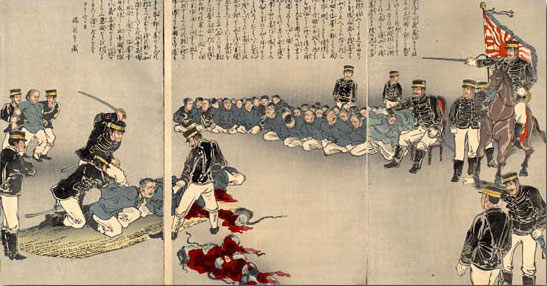
The Massachusetts Institute of Technology has taken down a history course Web page after a 19th century wood-print image of Japanese soldiers beheading Chinese prisoners sparked complaints from Chinese students and led to an apology from one of the course's professors. The "Visualizing Cultures" course, which uses images from the Sino-Japanese War of 1894-1895, was spotlighted Sunday on MIT's home page. It was pulled late Tuesday afternoon, and the school hosted a forum Wednesday for students, particularly those in MIT's Chinese community, to voice concerns. (AP)

John Dower took full responsibility for selecting the images and writing the commentary, explaining that to present propaganda images for educational use was not to condone their message... But the students could not grasp this point. Blinded by passion, they shouted that Dower and Miyagawa had been insensitive to the tremendous suffering of the Chinese people at the hands of Japanese militarism. One student undertook to edify Prof. Dower on the finer points of Japanese history by proudly presenting him with a copy of a popular book on the Nanjing massacre! Written demands circulated at the meeting included shutting down the site permanently, demands that MIT officially apologize to the offended “Chinese community,” and cancellation of academic workshops related to the site. (Perdue)

By this point an online hate campaign was under way against the two history professors involved, one of whom had the misfortune to be of Japanese ancestry. The MIT establishment was mystified as to where this outrage was coming from; it's not like images of graphic violence are hard to find on the internet, even those involving Japanese soldiers beheading Chinese victims. One group at the heart of the controversy sought to elaborate -

The MIT Chinese Student and Scholar Association, in a letter to MIT President Susan Hockfield, called for "proper historical context" at the top of the page, and asked for a posted warning that the images are graphic and racist.

"We do understand the historical significance of these wood prints, and respect the authors' academic freedom to pursue this study," the letter stated. "However, we are appalled at the lack of accessible explanations and the proper historical context that ought to accompany these images."
(AP)

So what was the 'historical context' provided on the original webpage?

Dower’s text describes one such print, entitled “Illustration of the Decapitation of Violent Chinese Soldiers,” which depicted Japanese soldiers executing helpless Chinese prisoners of war, as “an unusually frightful scene.” ... He continues, “Even today, over a century later, this contempt remains shocking. Simply as racial stereotyping alone, it was as disdainful of the Chinese as anything that can be found in anti-“Oriental” racism in the United States and Europe at the time – as if the process of “Westernization” had entailed, for Japanese, adopting the white man’s imagery while excluding themselves from it. This poisonous seed, already planted in violence in 1894-95, would burst into full atrocious flower four decades later, when the emperor’s soldiers and sailors once again launched war against China.” (Perdue)
Most would read this as a mundane condemnation of Japanese imperialism, as well as context-setting for subsequent East Asian history. But evidently a great number of Chinese people read it as a national insult and dismissal of China's historical grievances. Perhaps it was the use of the adjective 'violent' for the hapless Chinese soldiers, thoughthe description might be justified given that Chinese soldiers did commit atrocities in the 1894-5 war. But had that word been absent, chances are the reaction would have been the same - on trend.

Expressing political positions through violence (verbal or otherwise) is hardly unique to Chinese people; a good many freedom-loving, rule-of-law-respecting Americans have sent death threats to everyone from the Dixie Chicks to justices of the Supreme Court. But given the series of riots touched off over the past eight years by the Belgrade embassy bombing, soccer defeats by Japan and the Japanese government's approval of questionable history textbooks, a foreign observer might feel justified in making systemic conclusions about the 'New China'. Particularly if they're aware of unedifying local incidents like this one and Chen Yonglin's reception at Melbourne University last year, which occurred not merely outside China but within western universities, the institutional embodiment of free expression.

The last thing China needs is an image as a country of nationalist psychotics, who use past wrongs as an excuse to flout norms of civilised behaviour. Indeed the 'China Threat' lobby, which has long cast the Beijing regime as antisocial, has switched to painting the whole of Chinese society in these terms - a sort of high-tech Nazi Germany with a billion people. Still, it doesn't seem too much to expect respect from Chinese nationals for free speech, at least in other countries. It's not a hard concept - no one is obliged to tailor published material to others' sensitivities, short of hate speech or slander. And people express disagreement through reason, not insult and intimidation.

This should be doubly so in the case of academic enquiry. Stumbling across the MIT affair on China History Forum brought to mind an essay I wrote for a Japanese history subject a few years back on the 1894-5 war, including analysis of these same woodblock prints. Extracts follow -

'... foreigners were looking at the war not as an ordinary (i.e. European) great power conflict, but as a contest between two Oriental peoples. Japan's achievement was seen in contrast with the staggering corruption and incompetence of the Chinese 'war effort', if it can be called such. Japanese professionalism was cast in glaring profile by the benighted state of the Chinese soldiery, which in the absence of proper training and armament relied on superstitions such as carrying lucky chickens into battle or eating ground tiger bone to induce courage. Mutilation of prisoners, pillage of the civilian population and medieval practices like offering rewards for Japanese heas completed the image of a confrontation between modern civilisation and barbarity

'[in] contemporary woodblock prints... with their western uniforms and equipage, dignified poise and orderly dispositions, the Japanese soldiers in these pictures personify modernity. By contrast the Chinese, with their anachronistic display of colours and polearms, appear in a continuous state of chaos and defeat. The prints illustrate the triumph of modern substance over antiquated display...'
My essay was for a Japanese history subject, so it's written from a Japanese perspective. I felt no need to qualify it by listing Japanese atrocities against the Chinese people, by explaining that the Qing armies' dismal performance was not typical of Chinese history, by acknowledging that Japan borrowed its writing system, architecture and form of government from China etc. Yet had this been on the MIT website, I might have received the same treatment as Professors Dower and Miyawaga. Indeed being Chinese, I could have expected additional epithets revolving around 'race traitor'.

Remembrance and justice are one thing, hatred is another. These outbursts don't help China's civil society, Japanese attitudes or East Asia's political environment, which seems to be getting more corrosive by the year. Sometimes it seems to students of the region that nothing has really changed since Japan smashed the old order a hundred-plus years ago, failing to put something constructive in its place. And where better to reflect on that momentous war than MIT's online exhibition, which remains up and running - with a few modifications.


Non sequitur

The scheme by Japan's foreign minister to rope foreign ambassadors into a World War II commemoration has fallen through, apparently after Taro Aso realised they weren't going to grace an official function led by a man who refuses to acknowledge that his daddy worked Allied POWs to death.

And Greg Sheridan, who nearly self-immolated over the AWB affair, has utterly redeemed himself in my eyes with this piece on that other fractious Asian relationship (Australia-Indonesia). Not one line in that article I disagree with.

Friday, May 19, 2006

The Red Shadow of the Past


The Communist Party of China is big on anniversaries. When I visited Bejing in 1999, half the city was locked down after 7pm to allow dress rehearsals for the PRC's golden jubilee. China's tumultous history for the first half of the 20th century provides lots of nation-building material - the May Fourth Movement, the Nanchang Uprising, the Liberation itself - all suitably commemorated with flag-waving children, goosestepping soldiers and overdecorated floats.

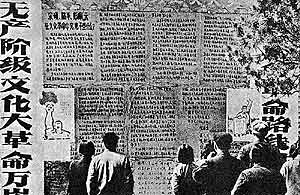
After 1949, the anniversaries stop. So this Thursday is likely to pass quietly, notwithstanding that it marks forty years to the day when a Peking University lecturer kicked off the Cultural Revolution. Nie Yuanzi was a radical forty-five year old when she stuck up her 'big character poster' denouncing the university authorities. She's now a pensionless eighty-five year old who shares a borrowed apartment with her pet cats and her memories, sharpened by seventeen years in prison; a victim of the monster she helped unleash.


Nie Yuanzi's dazibao

China must have a dialogue about the Cultural Revolution, says Nie, who was one of the Five Leading Red Guards but fell from grace when the political winds shifted in 1968. The reason is less therapeutic than prescriptive, to avoid a repeat catastrophe springing from a flawed understanding of history. One gets the impression that those scarred personally are past the need for reconciliation; the scattered but growing number of voices calling for a national debate talk about the future, as much as the past.

Certainly the responses one gets from people who lived through the "Ten Years of Chaos" remain laconic, even casual. Like a tutor of mine recounting how as a child she watched her father (a university lecturer) paraded through the streets in a dunce cap past baying mobs. Or a friend's father making off-hand references to his years as a teenage 'barefoot doctor' in one of the hundreds of rural counties that the Red Guard generation was exiled to from 1969, in an attempt to expiate the madness.

On top of the human cost, there's a need to confront the most comprehensive effort yet seen to destroy a nation's cultural heritage. I remember admiring the coffin of an Empress at the Ming tombs outside Beijing, complete with an apologetic sign explaining that it's a replica, the original having received the attention of axe-wielding Red Guards during the swinging sixties. Left-leaning western college students may still find the mass mobilisation and ideological fervour inspiring; Chinese intellectuals view it the same way that cultured Germans view the Nazi rallies at Munich.

But within China itself, the subject remains taboo. As far as the Party's concerned the matter was closed on June 27, 1981, with the Central Committee resolution pinning the blame on Chairman Mao and the counterrevolutionary clique behind him. Nie's is one of the few voices to penerate the blanket of censorship that still lies across the country, smothering even the one private museum dedicated to the Cultural Revolution.


The Cultural Revolution Museum outside Shantou

The root problem is that reevaluating the Cultural Revolution means reevaluating the role of Mao Zedong - and by extension that of the Communist Party - in the nation's history. China has yet to go through an equivalent of Russia's de-Stalinisation process. Instead the verdict on the Great Helmsman remains frozen in Deng Xiaoping's 70-30 formula: 70 per cent right, 30 per cent wrong. An honest discussion about the historical black hole from 1966-76 would open a political pandora's box, one that the Party has tried to keep shut with the weight of economic growth.

So this is just another instance of the CCP's propensity to sweep its problems under the carpet of history, if necessary by waiting for the main protagonists to die. Last year saw the exit of both Zhao Ziyang and Zhang Chunqiao, the last survivor of the Gang of Four. Neither the baggage of the Cultural Revolution nor that from the June 4th Incident seems to have impeded China's headlong rush to modernity; one of Zhao's proteges has even made it to Premier, while the memorabilia of Mao's personality cult now furnishes trendy cafes. But faced with the mounting contradictions of marketisation within the framework of a Party-State, China's leaders may eventually find that the cherished goal of national stability requires them to use history as a mirror, a lesson they readily dispense to China's neighbours.

As was observed about another national cataclysm, one that festered for a hundred years after the violence ceased:
"The past isn't dead. It's not even past".


Addendum

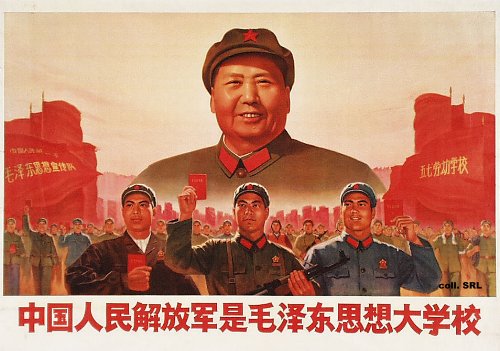
In case anyone's wondering about the slogan on the title picture:
"The Chinese People's Liberation Army is the Great School of Mao Zedong Thought"

Saturday, March 18, 2006

Lei Feng: The Next Generation

Your parents, assuming they grew up in China, were told to "learn from Lei Feng". Now you too should study this model revolutionary, because he represents the next thing in online gaming.

Learning From Comrade Lei Feng
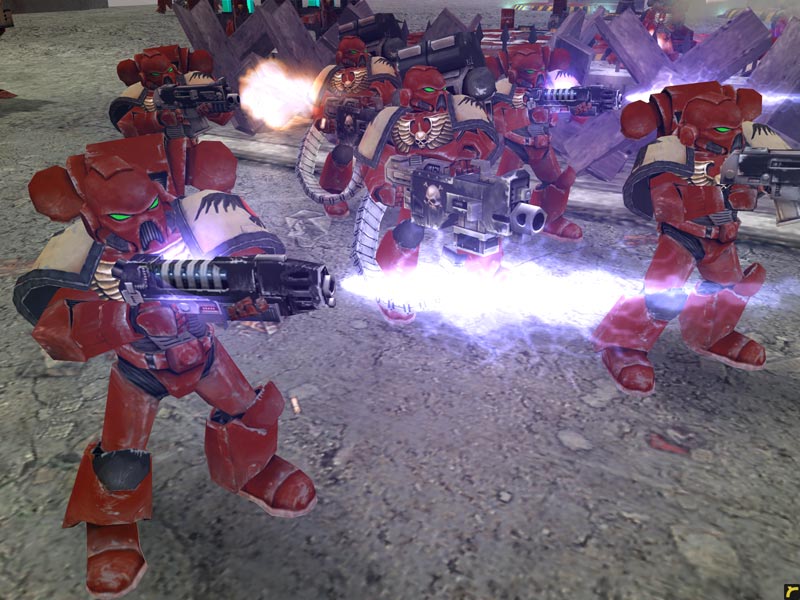
is the wholesome alternative to the bloodthirsty offerings that dominate the net-savvy, socially challenged young-adult male market. Try something new, you jaded gamers, and enter a world where success is measured by good deeds rather than bodycounts. Admonish spitters, volunteer on building sites and help old people cross the street, in exchange for poorer clothes and (ultimately) the chance to meet Chariman Mao. Not that you violence-addicts will need to go cold turkey: you get to battle hidden agents and other counterrevolutionaries.

It looks like giving his life for socialism wasn't enough for Lei, who's been summoned with other ghosts of China's past - like Zheng He - to battle the wave of moral decay swamping China's present.
Canute, I hear the tide coming in...


Which game to play... hmmm... thinking...


Footnote: Lei Feng's been rolled out of his grave for some time now. See this three-year old post at Peking Duck comparing him with Horst Wessel (not an analogy I endorse).

Thursday, November 10, 2005

Mission: Beheading Action


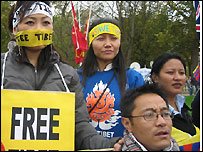
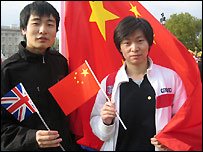
As if the London police didn't have enough to worry about, this week Chinese president Hu Jintao decided to complicate their lives by making a state visit. Last time a PRC leader stopped by (Jiang Zemin in 1999), the Bobbies lost face by manhandling the mandatory Free Tibet crowd. This time round, they hit on the simple expedient of keeping the prostesters on the north side of the Mall while seating Hu on the royal carriage's left, i.e. with a window facing south if you're heading towards Buckingham palace. Needless to say, Hu was far too polite to peer over the Queen's shoulder, saving both governments the embarassment of him having to see the prostesters' political message.

Hu gets a one-sided view of The Mall

It's unlikely that Hu heard it, either, as the Mall's south side was reserved for the President's homecrowd. The chanted slogans of the Free Tibet and Falungong army were cancelled out out by a roughly equal number of flag-waving PRC expats, some of whom travelled to London for the occasion. It might have been Whitehall's way of introducing Hu to the great British institution of the soccer riot. After all, they went to the trouble of illuminating London landmarks with red floodlights for Hu's visit, the first such show put on for China's benefit since British troops burned the Summer Palace in 1860.

In a strange coincidence, a similar pro-Beijing crowd packed the hall for a speech by rogue diplomat Chen Yonglin at Melbourne University a few months back. A large and apparently coordinated group of Chinese students - about half the 400 people in the audience - contrived to stop Chen even finishing sentences, through unbroken heckling, swearing and chanted paeans to the Motherland. As the media spin - and some personal conversations of mine - would have it, the individuals concerned took their marching orders from the local PRC consulate. These political contacts are allegedly institutionalised in an unnamed "Chinese students' association" at Melb Uni (which could mean any one of ten clubs). The idea is admittedly a small extension from Chen's claims, substantiated by other well-informed sources, that Beijing uses its private citizens abroad for intelligence-gathering and more mundane political activities, whether harassing CCP defectors or cheering visiting PRC grandees.

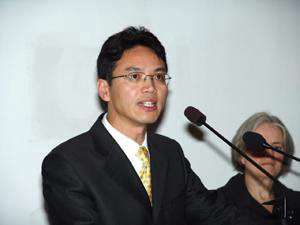
Chen speaks at Melbourne University on August 5. The lady on his left is Antonia
Finnane, the event coordinator and the history department's resident sinologist.


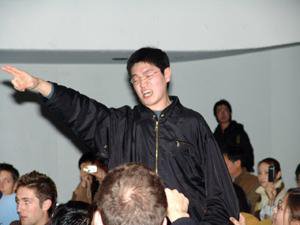
A local (Chinese) patriot takes Chen to task

I missed Chen on campus, but did go to see him speak that evening at Designs Australia in Carlton. I was hoping to spot placemen in the audience, but came out disappointed; there was no heckling to speak of, though Chen was grilled once or twice during question time, being called a traitor to his face by a local refugee advocate. By the end the heat was being turned on the event coordinator, who was accused of cherry-picking audience questions; at that point she decided to end proceedings in order to make the dinner booking at The Peking Duck on Lt. Burke Street. On the sidewalk outside, a heated argument between audience members offered a better chance to pick out consulate stooges, but I was distracted by a close look at Chen as he was hustled away. Maybe it's the boyish face, but my strong impression was of a young man out of his depth, being kicked around like a political football by various interest groups.

Chen certainly hasn't settled in quietly, with claims that he's now the target of a PRC hit squad, based on tipoffs from a friend inside the Chinese foreign ministry. Operation "Beheading Action"was allegedly authorised to make Chen an example that will plug the stream of Party desertions to western countries. Or maybe it's just designed to shut Chen up, based on his experience to date of indiscreet surveillance at dinner outings and close encounters with cab drivers. After the publicity surrounding his case, for Chen to now have an unfortunate accident would probably be a net political loss for Beijing. Chen certainly hasn't helped things blow over, with his post-defection speaking tour of Australia and a trip to Washington for a hearing before US Senators. As the Chinese proverb goes, the nail that sticks out gets hammered down...