Showing posts with label World history. Show all posts

Tuesday, January 17, 2006

China discovers the world... again


(c) The Age

Advocates of the "Chinese reached America first" theory have a new flag to wave in academia's face. This 18th century map, if it indeed replicates a 1418 original, proves that Zheng He's fleet circumnavigated the globe close on a century before Da Gama rounded the Cape. Unfortunately we have only the cartographer's word that the 1418 original existed, and the history establishment has already all but dismissed it as a fraud. A thread at China History Forum adds reasons to believe that a particular Beijing map-collector has been swindled out of US$500.

It's thus probable that the map says more about Chinese society today than during the Ming dynasty. It was bought by one of the legion of nouveau-riche collectors out to resuscitate Chinese civilisation, which after three decades of Party-stoked cultural suicide is in a bad way. The Party itself has long since jumped on the bandwagon in search of grist for the nationalist mill, and has adopted the 15th century voyages as the best monument to China's relative technical prowess one can find in three millennia of history. Orthodox Marxists might view them as unproductive extravagances that bled the masses, but what the hey.

The Ming fleet is all the more suitable as it can be personified in a photogenic admiral, who joins Confucius in a growing pantheon of rehabilitated feudal reactionaries. Zheng He paraphernalia to date includes a supra-lifesize statue, scale reenactments and a 600th anniversary stamp collection. Not bad for a guy who epitomises everything wrong with Old China - a wealthy eunuch who got his job through royal patronage.
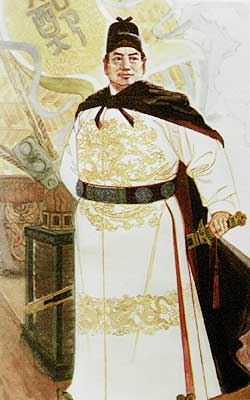

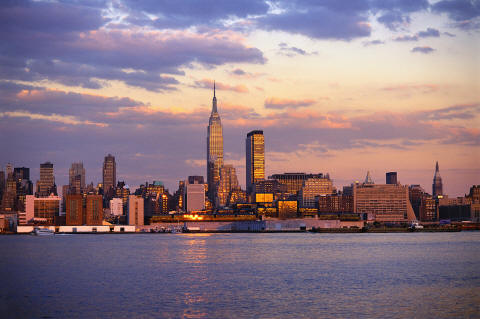
Then ... Now
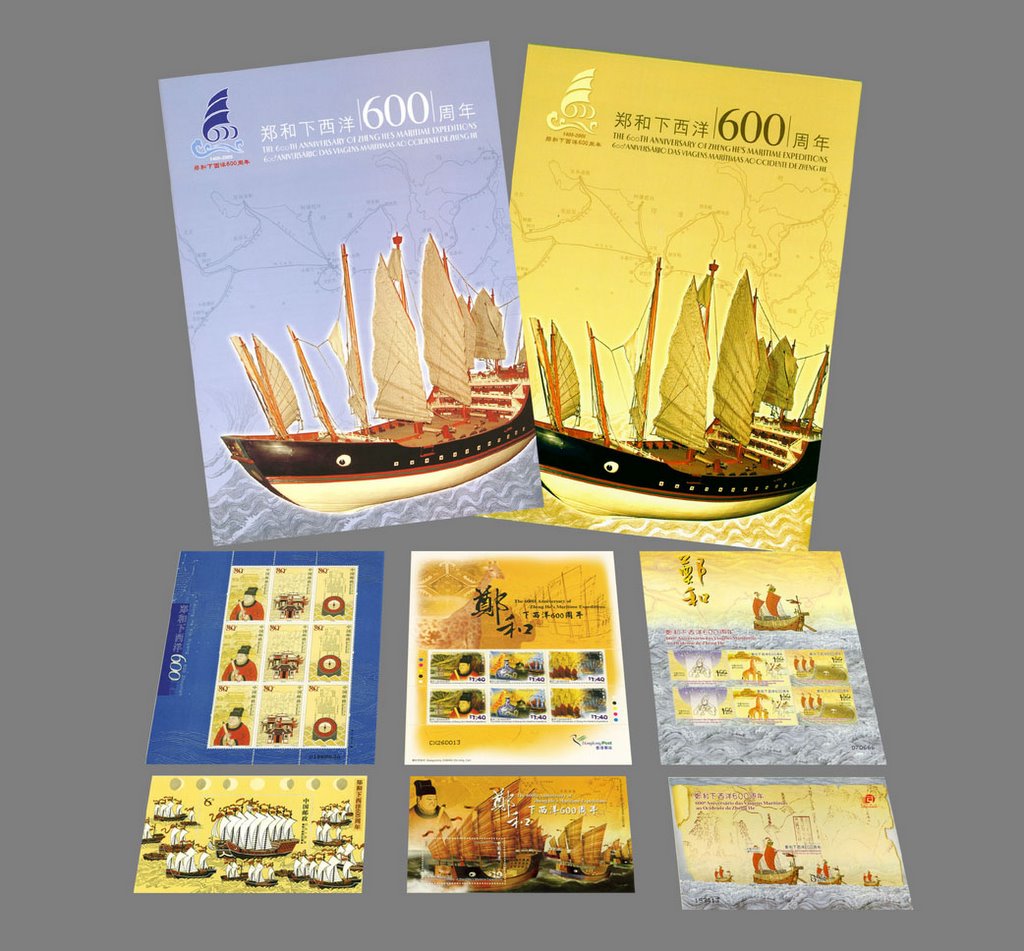
Saturday, January 07, 2006

Yali's Question


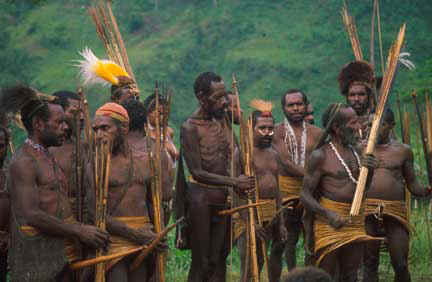
In an early post I said I'd use this blog to explore the differing success of human societies, in terms of material wealth and power. I've let that project slide, but the first instalment in a televised production of Jared Diamond's bestselling Guns, Germs and Steel has refired the historian in me. Not the show itself, which suffers from an excess of hammy reenacting and closeups of Diamond speaking in thoughtful monotones (he's a more engaging writer than TV personality). It's the question that the series grapples with; the question put to Diamond by his New Guinean interlocutor, Yali, which I'll paraphrase as follows -

"Why you white man have so much cargo, while we New Guineans have so little?"


By "cargo" Yali meant material possessions. His question lies at the heart of the 'new economic history' that has opened up fresh fronts for the culture wars - by exporting them backwards in time. Does Western dominance stem from culture, geographical accident or some combination of the two? Do nations have the power to shape their own destinies, or are some fated to be rich and others doomed to remain poor? Over the coming months I'll be probing the roots causes of the wealth and poverty of nations.

I'll try to avoid the Europhile/Europhobe distinction that hamstrings scholarship in the field and reduces the whole endeavour to a question of "are you for Western superiority, or aginst it?". The amount of flak Diamond's book has attracted is a case in point. His claim that had New Guinea been blessed with nutritious crops and large domesticable animals, its inhabitants would have gone on to invent helicopters riles the Right's defenders of Western exceptionalism. But his further assertion that they would, like the Europeans, have used their advantages to destroy less geographically endowed peoples draws the ire of 'Leftist' academia.

The vehemence of the attacks on Diamond symptomises the closing of the academic mind that seems to proceed inversely with our accumulation of knowledge. Rather than disdaining him as an interloper - Diamond is a biologist by training, not a historian - he should be valued for bringing in some cross-disciplinary perspective. Instead his book has become a football with which to score points for preexisting opinions.

Voltaire said that when two sides argue endlessly about a given issue, they are both wrong. A better conclusion is that the truth lies somewhere in between.

Sunday, August 07, 2005

The Day the World Ended


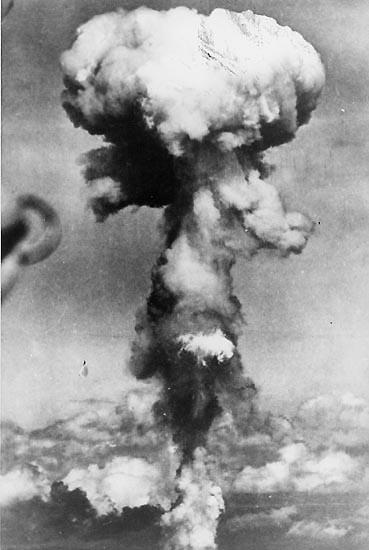
The 60th anniversary of Hiroshima has ticked over to revived debate about the action's utility and morality. Some points worth considering -

The moral significance of the atomic bombs was less dramatic in context then it appears today. By August 6 1945 US air raids had claimed some 800,000 Japanese civilian casualties, including some 300,000 dead. The decision to kill large numbers of civilians had been worked out over Dec1944-Feb1945, with General LeMay's appointment to USAAF 21st Bomber Command and the replacement of precision bombing with incendiary attacks. Area bombing and incendiary raids had been employed against Germany since early 1942, resulting ultimately in the deaths of between 750,000 and 1,000,000 Germans.

Conventional bombing had also comprehensively destroyed Japan's war economy by August 1945, so that in military terms the atomic bombs contributed nothing to Japan's surrender. In short, the atomic bombs were simply the logical extension of the strategic bombing campaigns against Germany and Japan. Only with the postwar development of missile technology and of steadily more destructive warheads did the implications of this new technology become clear.

Regarding the vexed question of the bombs' political influence, the key point is that Japan's surrender was achieved because of Emperor Hirohito's unprecedented intervention to command his cabinet to accept the Allies' demand for unconditional surrender. That the bombs were the immediate catalyst for Hirohito's decision is hard to debate, but once again it is unlikely that they were decisive in the larger context. According to his own statements Hirohito decided to command surreder because he believed continuation of the war would result in the nation's destruction, an obvious fact by mid-1945, i.e. before the atomic bombs were dropped. What Hirohito needed to intervene was sufficient support within the government and a deterioration in Japan's situation to the point where it was clear that surrender was the only alternative to national annihilation. Both these conditions had materealised by August 1945; Hiroshima and Nagasaki were less events in themselves than the apocalyptic climax to a long and violent process. Conversely, had Japan been in a position to feasibly continue the war, the dropping of two atomic bombs on Japanese cities would probably have failed to compel Tokyo's surrender.


Saturday, July 30, 2005

History's Grand Question


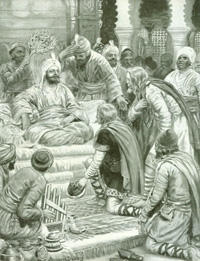
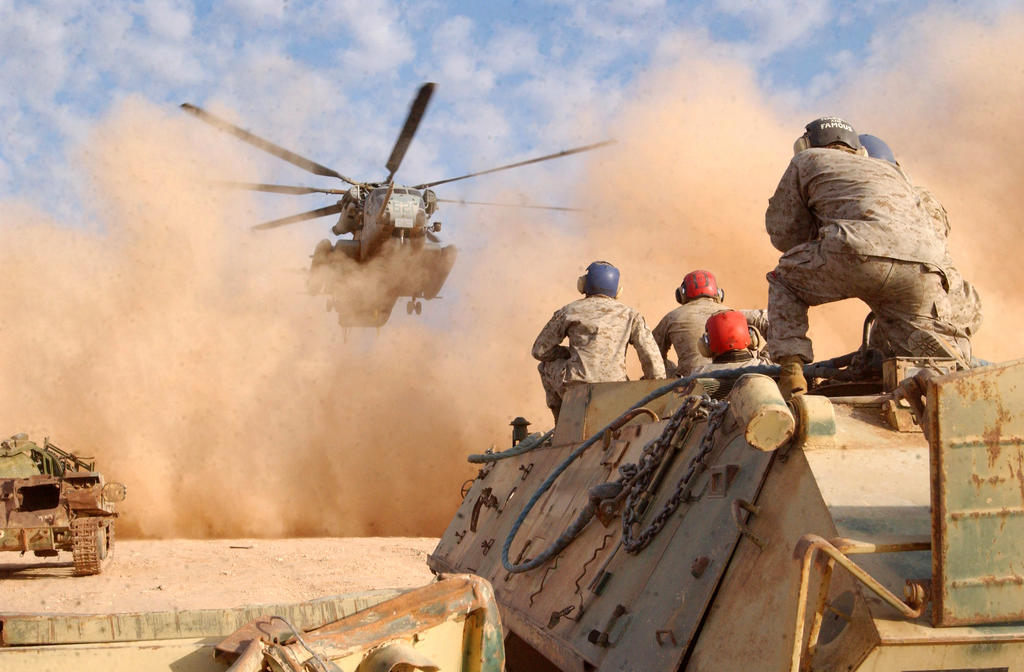
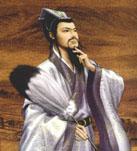
I came across the bottom image while searching for the top one.

The top image is an artist's impression of the 8th-9th century Caliph Harun al-Rashid receiving envoys from Charlemagne. Al-Rashid also maintained relations with the Tang Emperor at the other end of the Eurasian landmass, making Baghdad literally the centre of the civilised world.* I think the picture captures the relative positions of the West and Islam at the time - the primitiveness of dark age Europe compared with the refinement, wealth and power of the Muslim world.

The bottom image is of US marines conducting an airlift in Iraq. I think it expresses the contemporary relationship between the West and Islam, i.e. the latter's complete eclipse by the former: technologically, economically, militarily. I'm pretty sure these two juxtaposed images represent the context in which the occupation of Iraq and the broader 'War on Terror' is seen by Muslims round the world, a conclusion reinforced by discussions with Muslim friends. We are faced with a clash of civilisations, but one far more subtle than banalities about Islamo-fascists hating our way of life would suggest.

It's also a pictorial metaphor for one of the great questions of history, which I'll be exploring at length on this blog:
Why is it that among the world's civilisations, that which long seemed the least promising - what we call 'the West' - came eventually to build modernity and completely dominate the globe? (if you cringe at such cavalier use of the term 'modernity', rest assured I'll critique it in upcoming posts).

I say least promising because I'm treating 'the West' as a civilisation distinct from that of classical Greece and Rome, with its roots in the benighted Europe represented by the Frankish envoys in the picture. I'll be framing the discusison in terms of the debate between Eurocentrists, those who emphasise the uniqueness of 'western' civilisation, and anti-Eurocentrists, those who argue that the rise of the West was contingent - on timing, on geography, on the contributions of other cultures. My fascination with this question derives partly from my Chinese heritage (that of history's great second runner), partly from an academic interest that I sometimes have to remind myself isn't shared by everyone. But it does concern all of us, because the signs show that the age of western preeminence is passing. The defining phenomenon of the 21st century will not be terrorism but rather the rennaisance of non-western societies, which one can't comprehend without an understanding of how they fell so far behind in the first place.

History matters, people. And that's not self-justification for my Arts major. ;)


*Champions of New World civilisations will no doubt think that I'm a 'Eurasia-centrist'. Bear with me, I'll attend to the Americas in upcoming posts.