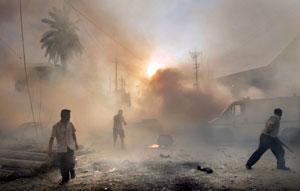
 Ambitious to start with a 3000 word post? Maybe, but this and the one above it have absorbed most of my spare time for the past week and a half. They'll be in the next issue of AAP, the magazine of the Melbourne Uni Political Interest Society.
____________________________
In 1999, LSE professor Mary Kaldor published a book entitled ‘New and Old Wars’. In it she argued that where ‘old wars’ were state-centric and fought between clearly defined armed forces, ‘new wars’ will be driven by globalisation and involve a range of actors competing for power amidst the wreckage of failed states. Iraq today exhibits all the traits of such a ‘new war’; it is afflicted by a kaleidoscope of violent groups who can operate because of the power vacuum left by the old regime’s collapse and popular hostility towards the occupying forces. This explains the US military’s manifest inability to pacify Iraq, despite having access to cutting-edge technology and a century’s experience of counterinsurgency warfare. The only way to defuse ‘new wars’ is to remove the failed state conditions that breed them, a task at which the Coalition Provisional Authority singularly failed due to a mixture of complacency, arrogance and ideological blindness. The danger now is that Iraq’s deterioration will reach a critical mass at which national institutions and cohesion break down faster than they can be rebuilt.
Until mid-2004 the official US line was that the insurgents were foreign jihadists and former regime loyalists, no more than 5,000 strong and lacking in genuine support within Iraqi society. When this picture became untenable, the insurgency was repainted as a regressive Sunni movement, led by former Ba’athists and driven by a fear of losing power in the new democratic Iraq. The guiding imperative was the Bush administration’s need to portray the insurgency as separate from and hostile to wider Iraqi society, thus absolving the US of blame for the violence and linking it to the global terrorist threat. For political reasons therefore the insurgency was treated as an autonomous and hierarchical guerilla force, similar to 20th Century communist insurgencies. The US military responded with appropriate tactics: targeting prominent insurgent leaders and strongholds, trying to cut the flow of recruits and assets across Iraq’s borders, attempting to win the ‘hearts and minds’ of Iraqi civilians. Yet in July 2005 the number of attacks continues to grow, with top US generals and even the Secretary of Defence now effectively admitting that there is no end in sight.
Calls for more foreign troops, ‘internationalisation’ of the foreign presence or pressure on Syria and Iran as perceived insurgent sponsors have faded, as it becomes increasingly clear that the nature of the problem has been misconceived. The insurgency is less an organisation than a social movement, defined by opposition to the US presence and drawing recruits from across Iraqi society and beyond: former regime elements, foreign volunteers, home-grown extremists, ex-soldiers, private militias, transnational terrorists, criminals, unemployed youths, sympathisers scattered throughout government and Coalition institutions. While their precise motivations may vary – the prospect of losing power in a US-shaped new order, blame attached to the US for Iraq’s problems, global jihad in defence of Islam – the common element is the use of violence against the US and anyone allied with it, including fellow Muslims. This is where the insurgency connects with the international Islamic terrorist movement. Both are fuelled by an ‘emulation effect’ that leads more and more individuals to take up proven means of striking at the perceived source of their grievances, resulting in a constantly growing network of autonomous groups. Thus the focus on numbers (the official US line now posits between 20,000 and 40,000 ‘hard core’ fighters with some 200,000 supporters) is misguided. The problem is not a limited number of fanatics who can be rooted out from wider society by force, but rather the conditions that facilitate the violence and breed popular hostility towards the Coalition.
Historical guerilla movements relied by necessity on a centralised command structure and on logistical support from outside sponsors or the civilian population; these were weak points that could be targeted by counterinsurgency efforts. In ‘new wars’, by contrast, a combination of state failure and globalisation diffuses the means of inflicting violence throughout society. Arms stockpiles left by Saddam’s regime make weapons readily available, and former regime officials use funds accumulated while in power to bankroll any group which fights the Americans. The breakdown in law enforcement and border control allows insurgents to bolster their resources through theft, looting and smuggling, to move easily around the country and to dominate local communities. Twenty-four hour media coverage enables isolated cells to identify vulnerable targets, determine which tactics and weapons are most effective and coordinate attacks with other groups; it also aids psychological warfare by bombarding Iraqi and international audiences with constant images of violence, peppered with especially horrendous incidents such as major bombings or televised hostage executions. The internet provides a communication, propaganda and recruitment system that is impossible to shut down, and gives anyone with a computer and telephone line access to technical knowledge ranging from bomb-making to urban warfare tactics. Rampant unemployment and criminality provides a vast pool of potential volunteers, and creates an environment in which citizens are under pressure to assist insurgents out of fear, opportunism or clan and ethnic loyalties. The process of rebuilding government institutions and the Coalition’s dependence on local translators and intelligence sources allows extensive penetration by insurgent sympathisers, facilitating sabotage and blackmail, providing targeting data and compromising counterinsurgency operations.
Widespread hostility towards the occupying forces both drives the insurgency and creates an environment in which it can flourish. Notwithstanding the impression gained from western media coverage, US troops are the main object of insurgent violence. Targeting patterns have been consistent for over two years: measured by the month, attacks on Iraqi civilians have comprised less than 5%, those on the new Iraqi security forces between 5% and 15%, those on Coalition forces between 75% and 90%. One reason that the training of new Iraqi security forces has been prioritised is the negative feedback generated by American troops: civilians refuse to cooperate with them or provide intelligence, hide insurgents and weapons caches and feed the enemy information about their movements. While this antagonism has its roots in natural distrust of an invading force, it has flowered from events after the invasion. The devolution of law enforcement on the US military meant that it was held responsible for the chaos that descended across postwar Iraq; it also dictated a pervasive US troop presence that created a sense of subjection to a foreign power, with all the attendant resentment and humiliation. Cultural illiteracy and a lack of interpreters among US troops inevitably caused friction with the civilian population, while repeatedly extended tours of duty in a guerilla warfare environment makes soldiers embittered and heavy-handed. Since March 2003 US military action has been one of the primary causes of civilian deaths and property damage in Iraq, and compensation is rarely forthcoming. Harsh security measures such as mass detention and incarceration without trial, and more flagrant abuses of power symbolised by Abu Ghraib, complete the image of an occupation in the worst rather than benign sense of the word.
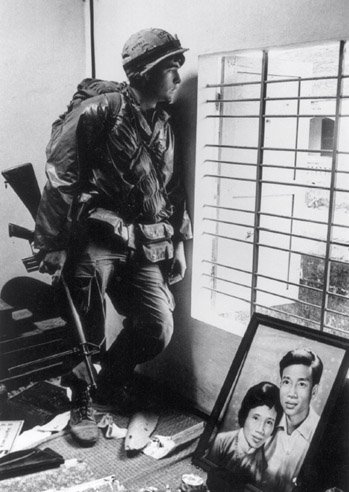
This accumulating hostility has been exploited by insurgents. Omnipresent violence forces the US military to keep swathes of Iraq under effective martial law, while collateral damage caused by attacks on US troops makes their presence unwelcome to the local population. Another tactic is to provoke excessive reactions from US forces. Targeting roadblocks leads US troops to adopt shoot-to-kill tactics that inevitably claim civilian victims. The November 2004 assault on Fallujah was (like the 1968 Tet Offensive) a tactical victory but a public relations disaster, producing footage of US troops shelling mosques and apparently shooting unarmed and wounded Iraqis at point blank range. In short the presence of Coalition forces in Iraq has come to mean violence for civilians, whichever direction it comes from; small wonder that polling data indicates that the general attitude towards Coalition forces is that they are at best a necessary evil and should leave as soon as possible.
Ultimately it is this willingness on the insurgents’ part to inflict wanton destruction that has confounded Coalition military efforts. Historically, guerillas sought to control the institutions and social fabric of the nation-state: the protagonists of ‘new wars’ seek to destroy them, to make way for alternative social orders based on narrower identities like race and religion, or simply to benefit from the chaos. In Bosnia and Rwanda, this involved ethnic cleansing to produce ethnically ‘pure’ political units. In Iraq today it means sabotaging the national rebuilding process, whether through indiscriminate violence, targeting economic infrastructure or sectarian killings, for instance bombings of Kurdish and Shi’ite religious festivals and tit-for-tat murders of Sunni and Shi’ite civilians. However oppressive Saddam’s regime, its institutions were a force for national integration; their disappearance has created space for an identity-based politics that aims to fragment Iraqi society along its ethnic fault lines, or simply set it on a downward spiral into anarchic warlordism on the lines of Somalia and Afghanistan. Short of violent repression, the occupying forces can do nothing to fight this trend; the only remedy is to displace it with the benefits of successful nation-building. Unfortunately, for most of the past two years ‘nation-building’ in Iraq has delivered an absence of security, basic amenities or employment, bickering politicians and a country policed by despised foreign troops.
The blame for this state of affairs rests squarely with the now-defunct CPA and the US administration. Their mistakes stemmed from a hubris that regarded the occupation’s merits as self-evident and not in need of active justification to the Iraqi people, and that saw fit to rebuild Iraq on US terms, without accountability or regard to actual conditions. A typical example was the disqualification of Ba’ath party members from public office, which disfranchised and alienated much of Iraq’s middle class. It also compromised the rebuilding process, since new institutions had to be created and new personnel trained from scratch; the fact that this was done on US models and by US contractors or government agencies only furthered perceptions that Iraq was being rebuilt as a US client state. The lack of concern by US and CPA authorities for financial accounting created a corruption-ridden political economy characteristic of ‘new wars’; the system rewards American companies and well-connected locals but has left ordinary Iraqis jobless or on third world salaries, and bears much blame for the lack of progress in repairing Iraq’s infrastructure or restoring its economic health. Perhaps most serious was the decision not to reconstitute or even pension off the old regime’s security forces, resulting in a power vacuum and giving the insurgency a valuable source of expertise. This error was compounded by failing to prioritise creation of new Iraqi police and armed forces from the outset, despite the chaos that immediately descended across the country; law enforcement and security were left to the US military, with the adverse consequences outlined above.
The only Iraqis involved in all these decisions were long-time exiles like Ahmed Chalabi, men who appeared to be US stooges and whose policy advice often proved faulty: they infamously assured their Pentagon patrons that US troops would be greeted as liberators, while Chalabi was a driving force behind the de-Ba’athification policies. The political movements and parties that emerged upon Saddam’s fall were initially given no voice, and their subsequent inclusion looked like cooptation into a hollow political process rushed through to combat the growing insurgency. Certainly the emphasis given to constitutional drafting, political horse-trading and other democratic forms while the country remained in ruins and under siege did not inspire confidence in the new regime. The CPA made no efforts to articulate a clear vision for Iraq’s future or to counter Saddam’s prewar propaganda, not to mention the inevitable postwar rumours and conspiracy theories. Iraqis were left to judge from what they could see: US officials moving into Saddam’s palaces, US companies setting up in fortified inner Baghdad, US troops establishing permanent bases around the country.
In short the Americans behaved like conquerors, with no regard for the needs or sensitivities of a population that had suffered greatly from previous US policies towards Iraq. Donald Rumsfeld’s glib response to the looting of Baghdad – ‘freedom is messy’ – was typical of the triumphalism and ideological certainty that governed the US approach to postwar management and precluded timely acknowledgement of problems, let alone responses. Such attitudes had in fact compromised the reconstruction process long before the invasion. President Bush’s decision to give the Pentagon control over postwar Iraq made the prewar planning effort hostage to the Defence Department’s civilian leadership, dominated by neoconservative ideolgoues. Planning was oriented around crisis events like WMD attacks and oil field sabotage that suited this group’s fixation with Saddam’s regime; it was diverted from broader political and security issues that they were convinced would not materealise under liberation by benign US forces. The State Department’s $5 million ‘Future of Iraq’ planning project was ignored, as were repeated warnings by US intelligence agencies of postwar armed resistance. Even within the Pentagon, planning suffered from political turf battles; officers of the Joint Staff were excluded, and when the Army’s Chief of Staff warned Congress of postwar security concerns he was stamped on by his civilian bosses. Ideological correctness trumped objective analysis. Vice-President Cheney blocked State Department appointments to occupation authorities; Cheney’s daughter was chosen over State Department career specialists to advise reconstruction czar Jay Garner; Garner himself had barely set up in Baghdad when he was replaced for opposition to the de-Ba’athification policies.
Where to now for Iraq? Coalition withdrawal is out of the question. The US withdrawal from Vietnam in the early 1970’s had few strategic consequences, either globally or regionally; Iraq by contrast occupies the heart of the most strategically significant region in the world. It is also hard to dispute Iraq’s emerging centrality to the global campaign against fundamentalist Islamic terrorism. The insurgency is not an entity but a cause, representing the use of indiscriminate violence to thwart the US and its allies. In material terms, Iraq now serves as the very sort of testing and training ground for militants that the war on terror is supposed to eradicate. The new Iraqi security forces are clearly years away from being to able to shoulder the country’s security burden by themselves. For all these reasons a complete US withdrawal is unlikely, regardless of domestic US public opinion.
Conversely, pouring in more foreign troops is not the solution. There are currently almost 160,000 Coalition troops in Iraq and yet, like Napoleon’s armies in Spain, they control nothing but the ground they stand on. Such a large and prolonged deployment is burdening the US economy, the US military and US foreign policy, to say nothing of domestic political damage to the administration. In this light the prospect of large US troop withdrawals by early 2006 (foreshadowed in a recently leaked British defence memo) is not that far fetched, especially when the apparent Taliban and al-Qaida resurgence in Afghanistan is added to the equation. What is most likely to happen is a progressive scaling down of the US presence towards a rapid reaction force, that would deal with major threats as Iraqi forces increasingly assume control.
Ultimately, Iraq’s fate lies with the new government’s ability to end the failed state conditions that allow the violence to grow. Former Interim Prime Minister Iyad Allawi said as much in a recent interview with London’s Sunday Times: “[without] national unity, the building of institutions, the economy … the country will deteriorate”. It would be comforting to believe that Iraq is now firmly on the right path, given recognition of the past two years’ mistakes and the presumable preference of most Iraqis – after decades of Saddam’s rule, the Iran-Iraq war, the First Gulf War, UN sanctions, US invasion and finally the insurgency – for national reconstruction over the continued strife and uncertainty entailed by the alternatives. But the facts do not bear this out. Trust in the new government is being eroded by growing evidence of human rights abuses by its security forces and of an interior ministry fast becoming a facsimile of Saddam’s, with paramilitary units, extra-judicial executions and an alleged secret network of torture centres across the country. Shi’ite domination of the new security forces makes them vulnerable to abuse as a tool of sectarian violence, with elite units like the Wolf Brigade already accused of waging a covert war against the Sunni community. The inability to disarm sectarian militias such as the Shi’ite Badr Brigade (the armed wing of Iraq’s largest political party) leaves them free to fight ‘insurgents’ according to their own interpretation and provoke response in kind; Zarqawi’s organisation has reportedly set up a special division solely charged with eradicating the Badr Brigade. The mutually hostile Kurdish factions in the north remain independent of Baghdad, and there have long been reports of ‘soft’ ethnic cleansing in areas under their control.
Economically the picture is not much brighter. Iraq’s GDP continues to shrink, with the oil sector – now representing 95% of national income – struggling under the weight of sabotage, mismanagement and the corruption. As noted above, corruption has become endemic in post-Saddam Iraq, thriving on a lack of adequate controls; the CPA’s own auditor found it unable to account for $8.8 billion handed over to Iraq’s Interim Government, while there is still no system for monitoring the army of US contractors absorbing reconstruction funds. The domination of Iraq’s economy by American companies sucks money out of the country and has made it impossible to dent the unemployment rate, which is now at 50% and rising. Violence and its accompanying security costs deter foreign investment. Two years on from Saddam’s overthrow one in three Iraqis is malnourished, while one in six survives on a food rationing system. Most worrying is the US failure to deliver the promised sums for Iraq’s reconstruction, with Secretary of State Condoleeza Rice recently confirming that of the $18.6 billion voted by Congress only $7 billion has been spent.
Iraq’s new government has come into existence saddled with too many problems to overcome with the resources at hand. Its only hope is adequate support from its US patron, not just in military terms but comprehensively. Unfortunately it seems that the Bush administration, having invaded Iraq with no plan for winning the peace, has failed to develop one in the two years since. Allawi bluntly told the Sunday Times that “the Americans have no vision and no clear policy on how to go about in Iraq”, an extraordinary comment from a man in his position and a warning about how serious the situation is. With Baghdad now under continuous siege from suicide bombings and Iraqi politicians openly speaking about civil war, it seems that Colin Powell’s famous warning to the President way back before this all began – ‘if you break it, you own it’ – has come home to roost.