Showing posts with label reviews. Show all posts

Tuesday, June 13, 2006

Ancient Trip


As a sucker for big-budget period flicks, I used to feel that I'd been born a generation too late. In the 90's the age of Charlton Heston and the Shaw Brothers seemed gone with the wind, excepting the odd hobby project of cash-flush actor-directors (think Braveheart and Dances with Wolves). But like so many other cultural spheres, cinema has seen the secular tide of the late 20th century turn, with Hollywood churning out a string of sword-and-musket dramas: Gladiator, Saving Private Ryan, Enemy at the Gates, Count of Monte Cristo, Master and Commander, Troy, Alexander, The Last Samurai, The Passion, The New World, Apocalypto.

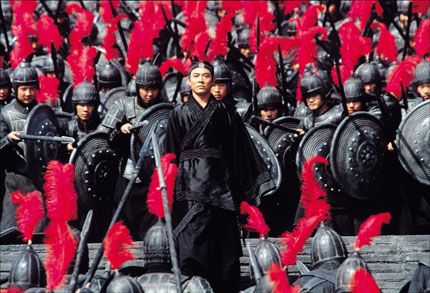
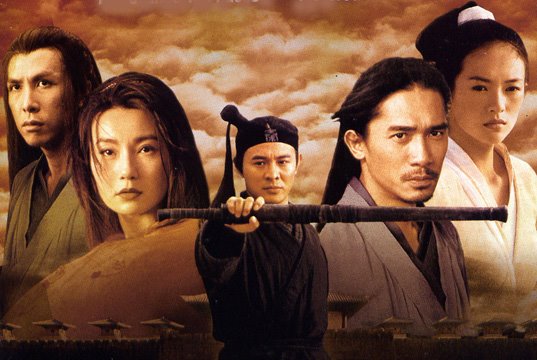
Chinese (Hong Kong, Taiwanese) cinema has never really gone off the historical theme; 3500-odd years of unbroken tradition weighs heavy on the national consciousness. But it was only in 2002 that Chinese period drama broke into the western mainstream with Zhang Yimou's Hero, which I was rewatching last night. Four years on is a bit late for a film review, but I just realised why I like this movie so much.

It's not for the plot, a creative but unconvincing take on the scheme to bump off the King of Qin before he unified China; so creative in fact that this film can't qualify as historical fiction but needs a new genre, 'historical fantasy'. What message comes through has propagandistic undertones: both Jet Li and the King are true heroes because they put China's unity first (cough, *Taiwan*, cough). Excessively cynical perhaps, but I can understand why some critics claim that Hero plays the outwardly opulent but spiritually impoverished cousin to Chen Kaige's Emperor and the Assassin, which covers the same historical subject matter.

No, Hero wins through wholly on its aesthetic credentials. From beginning to end, it's a riot of colour and composition that leaves the viewer too breathless to question the point of it all. Leave it to Zhang Yimou to prove that - given an all-star cast and a decent musical score - eyecandy can a classy film make.


It's this visual and audial accomplishment that explains why, for me at least, the film isn't spiritually impoverished at all. Hero veritably channels ancient China: not the sweltering coastlands my ancestors come from, but the northern plain and the loess highlands in their severe grandeur, the heartland of Han civilisation. For many nations, physical geography is a key component of national identity, and Hero stunningly evokes the natural and manmade landscape of antique China. Though I was born in Malaysia and raised in Australia, it ignites my connection with a culture that was old when Jesus was born.

Maybe I'm just an atavist, but if so why is the movie industry increasingly catering to tastes like mine? Perhaps we do live in a soulless consumer age - an age in which historical reenacting is a growth industry, political discourse resounds with the clash of civilisations and religious conversion is on the rise - that's turning people back to their cultural roots; trying to relate to the present through the prism of the past. With British admirals warning that we're about to relive the fall of the Roman Empire and the Barbary pirates, anything seems possible...

Saturday, May 13, 2006

Mission: Improbable


The best way to spoil a movie is to watch a TV drama with the same material the night before. So watching Threat Matrix on Thursday (it's on after Scrubs) may have jaundiced my opinion of Mission Impossible 3. Then again, one can only spin so much from the worn threads of spy gadgets, undercover agents and evil European arms-dealers.

Numerous Spoiler Warnings

The first question to ask when making a movie is whether you want the audience to take it seriously. If the answer is 'yes', then you should avoid scenes with special agents wise-cracking and discussing their engagement plans en mision. Or helicopers flying between the blades of wind turbines while the hero performs defibrillation on board. Or people sticking nitroglycerin bombs up other people's noses for no reason, other than 'because we can, and we're sadistic bastards.'

MI3 has all these things and still expects us to suspend our well-paid-for disbelief. How a film with scenes of torture and executions got a PG-13 rating I'll never know, but it works hard to achieve a grim realism. Villain (#1) talks up a DaVinciCode-style conspiracy - "you have no idea what you're dealing with, do you?" - that involves a doomsday weapon innocuously called the 'Rabbit's Foot'. Villain (#2) provides the now-mandatory reference to contemporary politics, through a half-boiled scheme to sell the Rabbit's Foot to Middle Eastern jihadists and then send in the US military to clean up: "democracy wins".

The material's stale, but I might still have cared had it led somewhere. Intead it's been cobbled into a circular plot with more leaks than a boatfull of asylum seekers. If Davian's so confident about the Rabbit's Foot, why does he need Hunt to steal it? If Musgrave wants it, why didn't he just send Hunt? What's the point of having faux-Julia shot after Hunt provides the Rabbit's Foot? For that matter what's the point of any of this, seeing as we're never told where the Rabbit's Foot comes from or even what it is?

Denied a coherent story, the film's left to hang the explosions and gadgetry on a parade of undeveloped characters. Phillip Seymour Hoffman doesn't quite pull off the transition from Capote to sadistic, English-accented criminal mastermind. Billy Crudup might have made an adequate backup villain had he revealed himself before the last 15 minutes of the film, and been given one more scene before losing a pistol duel with Hunt's gun-innocent wife. Only the acid-tongued Laurence Fishburne stirs some interest, until we find out that he's not the bad guy after all.

None of this need disappoint if you paid to see Tom Cruise running, driving or falling for half the movie, preferably against exotic backdrops (German windfarms, the Vatican, Shanghai). Agent Farris may need an adrenalin shot to get her going, but not Ethan Hunt, who goes from blasting predator drones out of the sky with an assault rifle to being zapped with a nerve-agent to breaking out of IMF headquarters with a penknife, without so much as a catnap. This superhuman resilience doesn't leave Cruise many opportunities to act. Among these precious moments, the more convincing ones are not those with Julia but Hunt's flashbacks about Farris, and his internal conflict over having sent a young agent to her death. But even this gets submerged in the pointlessness of the whole exercise.

MI3 has the rush and the effects; it just lacks creativity, a convincing story or characters that the audience cares about. I enjoyed the fact that Hunt's agency is called the 'IMF' (Impossible Missions Force) and the bit where Hunt's crew confound ex-PLA contractors with a tennis-ball machine. Maybe if I hadn't been up till 1:00am that morning watching another show about American secret agents saving the world, I would have been more charitable.

Or maybe not.

Tuesday, March 07, 2006

A New York comedian in LA (or "Jon Stewart at the Oscars")


(c) Hollywood Reporter

This year's Oscars began with a farcical montage of ex-hosts refusing to show for 2006, and for good reason. The way Jon Stewart has been crucified over the past 48 hours, you'd think he'd presided over the invasion of Iraq rather than the 78th Academy Awards. There's some irony in the most anti-establishment comic in America being told to keep his 'day' job by liberal bastions from Slate to the Washington Post. Especially when the only way to sit through this three-hour mediocrity-fest was to treat it as an extended episode of The Daily Show.

It seems that Stewart's years as a satirical TV host have made him forget Stand-Up-Comedy 101: the devil's in the audience. He visibly faltered at the forced rumbles or walls of silence that greeted his jokes throughout the night, or at least those at the audience's expense:

"I guess it's the one night of the year where you can see all the stars without having to donate any money to the Democratic Party."
"And it's exciting for the stars as well, because it's the first time many of you have ever voted for a winner"
"There are women here who could barely afford enough gown to cover their breasts."
"And that's why I think Scientology is right not just for this city, but the entire country."

Given that Stewart's performance was sprinkled with jibes at the media, politicians, Jews and himself, you'd think an audience of several hundred celebrities would feel secure enough to cop it in good humour. As it was, the only gag to get a bona fide response involved Dick Cheney shooting someone. Perhaps they were expecting nice, neutral Bush-bashing rather than cutting critique of their own lifestyle and politics.

The dearth of savoir-faire was epitomised by George Clooney, who followed up Stewart's jibes about Hollywood being a "moral black hole" and "out of touch with mainstream America" with an aggressive on-stage defence of tinsel town's progressive values. Apparently it didn't occur to him that Stewart might have been talking tongue-in-cheek, which is after all what the man does for a living. Either that, or Clooney seized the chance to make yet another political statement, on top of the two films for which he got nominations (and an award).

If Spielberg had the grace to praise Stewart's performance, after the crack about Schindler's List and Munich making two legs of a trilogy, we can expect a tad more forbearance from the glitterati. As it was, they seemed to prefer Ben Stiller prancing around in a green leotard. Those Hollywood sophisticates...

Sunday, February 19, 2006

It Seems... Right


This book tries to paint a portrait of the conservative movement - of the people and institutions who have been responsible for pulling America to the right over the past thirty years. ... [however we also] try to examine why America is such a distinctive country ... so much more conservative than other advanced countries...

Sometimes an outsider's eyes are the keenest. The Right Nation gained fame for predicting a Bush win in 2004, but this attempt by two Britons – Economist (US) editor John Michelthwait and Washington correspondent Adrian Wooldrige – to probe America's political soul takes a longer view. These 21st-century Tocquevilles have produced what is arguably the best overview of the US conservative movement in print. More controversially, they argue that America is a naturally conservative nation.


They begin with an overview of the Republicans’ five-decade transformation from the party of the East Coast elite to that of the populist hinterland, from the party of the patrician and internationalist Prescott Bush to that of Prescott's bible-quoting, Texan-drawling grandson. The GOP’s reinvention is quite a tale in itself, but for the authors it’s the political face of a wider phenomenon: the rise of American conservatism, from a handful of fringe voices in the 1950's to a mass movement that dominates US politics.


It’s this story the book shows us, through an engaging milieu of interviews, travel journalism and history. The Right Nation is worth the read simply for its dissection of the empire of think-tanks, foundations, media outlets, political action committees, lobby groups, community organisations and talkback radio stations that US conservatism has built up over fifty years. One’s left in little doubt that notwithstanding their underdog complex, conservatives have become a rival establishment, whose influence will far outlast the 43rd presidency.

This new order has much stronger roots in US history than the liberal, internationalist face the US once presented to the world. America, Michelthwait and Wooldrige contend, is and always has been an essentially conservative nation. The country’s Puritan roots gave it an atypical religiosity and place for morality in public life. The Revolution bequeathed a constitutional system designed to limit government and preserve the status quo, and a political value set that cherished individual freedom over social engineering, however noble the cause. A seemingly endless supply of new land and opportunity spared American society the upheavals and revolutionary projects characteristic of the Old World. This political heritage is continually regenerated through education and public life, reinforced with the prestige of age; despite its mythology of national youth, the United States is one of the oldest countries in the world.

All this explains why the US has proved fertile ground for a popular conservative movement, a phenomenon unknown in other first world countries. Elsewhere in the developed world, the 'right' is a minority political party or extremist fringe group. In America it is a vast host drawn from across the social spectrum, mustered beneath a range of banners – gun rights, land rights, tax reform, abortion, homosexuality, school prayer, law and order, ‘family values’ – against the spectre of liberal elites out to destroy the American way of life. That way of life is defined by traditionalism, suspicion of government and exaltation of individual choice. The losers in this mix are equality, progressive social attitudes and state intervention – all things connoted by 'liberalism' in the US.


If you take one impression from The Right Nation, it’s the historically-grounded uniqueness of US ‘conservatism’: its
populism, anti-elitism and progressive, almost messianic outlook are the opposite of what the term implies elsewhere. It's inconceivable that organisations like the NRA or the Christian Coalition could flourish in any other developed country. Where else in the developed world do four in five people identify as Christian, or one in three households own guns? Where else do 38 out of 50 states (plus the federal government) apply the death penalty? Where else is home-schooling a legal right in every state? America’s unforgiving treatment of lawbreakers, its hostility to state restrictions on laissez-faire, its confidence in the superiority of its social model, all set it apart from comparable societies.


The authors’ central point is that this package of attitudes, while it may have regional accents, is mainstream across the United States. From the Californian hinterland to the industrial Midwest, from small-town New England to the booming suburbs of Arizona, Americans have attitudes to basic social questions that differ significantly from the consensus elsewhere. Alone among developed countries, the US has never had a radical labour movement or a "left-wing" government, still lacks a comprehensive healthcare system and tolerates the biggest wealth gap in the Firs
t World* (surveys show that one in three Americans believe they will eventually get rich). US governments, Democrat and Republican, have consistently opposed recognition of 'social and economic' rights (as opposed to civil liberties) and efforts at supranational governance, such as the International Criminal Court. And even accounting for a ‘9-11’ effect, the overall public attitude in the US towards defining and prosecuting the ‘War on Terror’ – and specifically towards invading Iraq in 2003 – clearly differs from that overseas.


The Right Nation’s argument throughout is lucid, thorough and sufficiently nuanced to be convincing. The conservative movement they portray is a heterogeneous creature, with its share of internal contradictions – notably tension between 'small-government conservatives', who want the state out of their hair, and 'social conservatives', who want it on their side. But the big picture is of a national majority that, inverting Lyndon Johnson's famous statement about liberalism, stands against a lot of things and in favour of a mighty few.


The authors likewise avoid the pitfall of claiming that all Americans are conservatives, even latent ones; if nothing else, voting numbers in the last two presidential elections show that Blue, ‘liberal’ America represents a large chunk of the country. But the book makes a good case that Red America is bigger, and in the ascendant.

There are plenty of liberals in America, [but] liberalism as a governing philosophy is dead... Any hope of liberal America breaking out of that stranglehold is limited by what might be called the rule of the two-thirds: only one-third of the population these days wears the Democratic label, and only one-third of those Democrats describe themselves as liberals.

Looking forward, the authors can’t offer much for American liberals. US conservatives have demography as well as history on their side, with a young and growing population that leans right across boundaries of ethnicity and profession. Factor in trends ranging from union decline and rising share-ownership to the ‘War on Terror’, and it does seem that the Republicans are America's 'natural party of government' for the foreseeable future; certainly until the Democrats arrest the downward spiral into which their leftward turn during the 1960’s sent them.


The record shows that a party unable to play the conservative tune can’t build an election-winning base in the United States. The first two Republicans voted to the presidency after the 1960’s were both Californians; the two Democrats elected since then were both Southerners who in any other country would pass as right-wingers; in 2004, John Kerry lost because he failed to win constituencies (e.g. Ohioan blue-collar workers) that were pillars of the old Democratic coalition. Over the past four decades, conservatives have consistently set the political agenda, churned out the new ideas and tightened their hold on legislature and judiciary. It’s a grim outlook for anyone who’d like to believe that George Bush is a national anomaly, or that the Right’s dominance in America is somehow artificial and transient.


The Right Nation
marshals a wealth of anecdotal evidence and historical background into a coherent political profile of a nation, complete (in the second edition) with a postmortem of the 2004 election. If the book has a major weakness, it’s in its overseas comparisons; reading this book it's easy to forget that the world, even the 'developed' world, is wider than NATO. But while one may dispute the authors’ approach and conclusions on a specific issue, it’s hard to fault their objectivity or the explanatory power of their thesis. One’s inclined to accept their verdict on America's conservative triumph, borrowed from the words of their French predecessor: "so inevitable, and yet so completely unforeseen."

* In the late 1990's, 1% of the US population controlled 38% of national wealth.
Wednesday, December 21, 2005

Monkey Magic


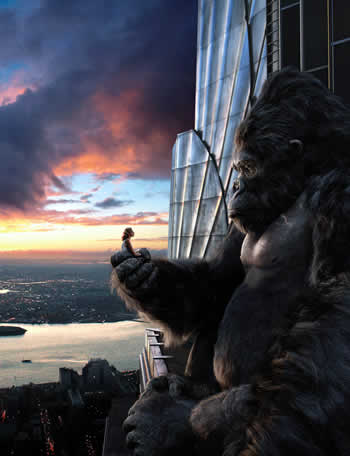
Yes, I know gorillas aren't monkeys. But since Peter Jackson's remake of the 1933 classic wins through on special effects, it seemed a witty title for this review. As we're being asked to suspend disbelief in a twenty-five foot ape that kills tyrannosaurs, does the zoology really matter?

Spoiler warning (read on anyway, you know what happens)

A King Kong remake was always going to trade on spectacle, and Jackson doesn't disappoint. Everything in this movie is big - the ocean, the island, the creatures, New York - splashed across the screen with lavish camera angles and equally lavish effects. You can really believe that you're racing down a canyon with colleagues being stomped left and right by stampeding brontosauruses, or exploring the surf-lashed hovels of the wretched natives who cling to life on Skull Island's jagged shoreline. In homage to the original film, the Weta FX gurus have rendered the critters lifelike while retaining the faux look of those in the 1933 movie.


Tying it all together is the meticulous choreography (shown to best advantage in Kong's three-way fight with the tyrannosaurs) and attention to detail that marked Jackson's Rings trilogy, whether the backdrop is prehistoric jungle or Depression-era New York. It's more than enough motivation to sit out the film's 187 minutes.

That said, King Kong is too long by at least a half-hour, or the cumulative length of those scenes that should have been cut and relegated to the extended DVD version. It suffers from Jackson's misguided urge to elaborate on the original film's spartanness. Scenes-too-far include the bug battle at the ravine bottom and a ridiculous ice-skating sequence in Central Park, giving this film a contrived feel that contrasts with the original's simplicity. Unsurprisingly, the best moments are the iconic ones lifted more-or-less unscathed from the original: Kong's fight with the tyrannosaur (now tyrannosaurs) and the biplane-filled finale on top of the Empire State building.

Perhaps unavoidably given the subject matter, Jackson's film is studded with unconvincing plot devices, such as having hitherto-docile denizens of Kong's cave attack him at the point that Driscoll needs a diversion, or asking the audience to accept that Denham and co. get Kong to the Venture on a lifeboat and then to the US east coast on chloroform. Using a stand-in for Anne at Kong's Broadway premier breaks the plot's linearity and requires Jackson to engineer a reunion, an error he compounds by filling the interlude with more gratuitous scenes, in which Kong chases Driscoll around New York and tosses aside Anne-lookalikes. (In fairness, the 1933 film has Kong discard a hapless lady from thirty stories up in his search for his one true love).

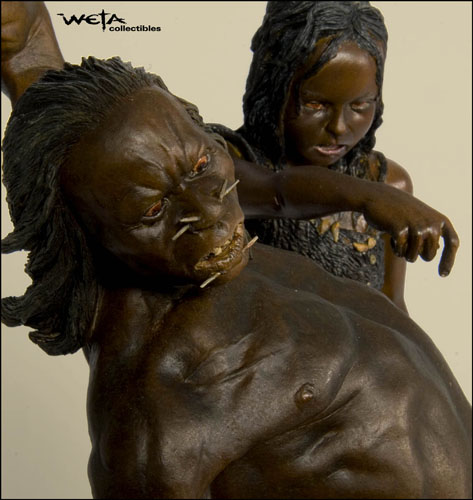
It's the human element, Naomi Watts aside, that lets this movie down. The grass-skirted natives in the 1933 original had more personality than Jackson's Orcish-looking creatures (living on a Mordor-looking seafront). I'm not the only one to notice this - check out AnonLefty's take - and the film would have benefited if Jackson had given Skull Island's denizens some depth. Instead we get gibbering, voodoo-stoked wretches whose lives revolve around human sacrifice, and who welcome strangers by bashing their brains out with maces.


As if for balance, the white people receive uneven and truncated character development. A raft of characters - Anne's Broadway colleagues, the Venture's crew, Denham's filming team - are either killed off before we get to know them or denied the necessary screen time, often both. I liked Jack Black's Denham initially, but soon found him a pretentious prat and myself wishing for Robert Armstrong's hard-jawed original. Bruce Baxter is set up as a spoilt actor stereotype, then redeemed by having him lead the rescue expedition; then we're made to dislike him again when he steals Driscoll's thunder at Kong's Broadway premier. Worst is the contrived romance between Anne and Driscoll - one minute you don't see it, the next you do. Naomi Watts has more chemistry with the giant ape, apparently a delibrate departure by Jackson from the 1933 template.

In the original Kong, Anne failed to requite the monster's infatuation; the final sequence is kicked off by her confiding to Driscoll how Kong's escape is like reliving all the horrors of the island. Thus Kong remained a beast to the end, giving Denham's closing line its punch. In this version it falls like a wet towel, because Kong's bonding with Anne has humanised him, a feasible transformation thanks to computer modelling that captures a human actor's facial expressions.

Unfortunately, even this central relationship is sketchily developed. Between rampaging through jungle, fighting dinosaurs and shaking off rescuers, Kong just doesn't get much private time with Anne on the island. As if suddenly aware of the credibility gap, Jackson devotes most of the film's last half-hour to fleshing out the pair's reciprocal affection, even during the biplane attack scene. Ultimately I had to take it on faith that Anne just has a generous spirit, and warms to the creature that ate her predecessors as a misunderstood softy.


In short, the show's real star is indeed the twenty-five foot gorilla. Wonderful as that is - and many reviews are billing Kong as a film of 'heart', even a tear-jerker - it means that Jackson's epic fails to transcend being a giant monkey movie (there I go again!). There's charm in its sheer scale and the novelty of empathising with a monster, but in the long run it'll join the pile of big-budget remakes. I enjoyed it, but I hope that Jackson and the New Zealand film industry don't get stuck in a rut of mammoth CG projects, visually stunning but otherwise superficial.

Remember, it was beauty killed the beast...

Saturday, September 10, 2005

Universe of Battle

It's hard to imagine more obvious RTS material than Warhammer 40,000, but fans had to wait over a decade after the genre came of age for a developer with the guts, gold and Games Workshop support to pull it off. Relic Entertainment has marketed Dawn of War as an industry-defining game that focuses on 'visceral frontline combat', a phrase that appears six times on the game's FAQ page. Unlike traditional RTS, which allegedly revolves round attacking the enemy's supply lines (his 'peons', in case you're not sure which competition Relic's referring to), DOW keeps play at the sharp end through an economy based on controlling 'strategic points' and combat squads that can be reinforced where they stand (by teleportation).

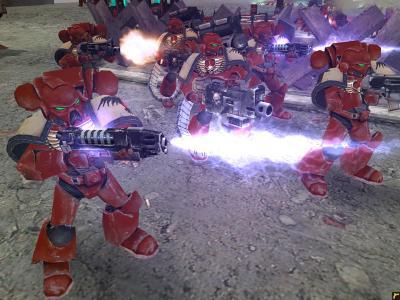
DOW certainly delivers unprecdented unit animation, and atmospherics normally reserved for FPS heavies like Medal of Honor - the screen shakes, combatants yell out randomly, explosions send bodies and terrain flying, etc. Most impresive for an RTS are the hundreds of combat animations, including unit-specific kill sequences that are the most shameless pandering to bloodlust I've ever seen in a computer game (then again, it is Warhammer). By Relic's own admission the camera zoom has no gameplay function, being designed entirely to let you enjoy the carnage up close or from any angle of the compass.
Add a gothic soundtrack, and it really does feel like you're in the 40K universe. A universe of battle.


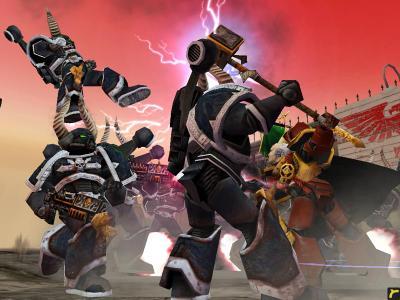
Captain Angelos teaches traitors to fly

Unfortunately this aesthetic glory has, to some extent, come at the cost of that crucial element of playeability which marks outstanding RTS games. No one cares that Warcraft looks cartoony because the gameplay is so involved. In DOW one often gets the feeling of having nothing to do besides upgrading and placing units in the right spots, as if Relic was afraid of distracting you from that visceral frontline combat. The squad system doesn't leave much room for micromanagement, and renders the numerous upgrades meaningless for gameplay purposes. Even given the constraints of its chosen model however the gameplay suffers from several avoidable defects, such as excessive cooldown times for those abilities that you do control. DOW does at least overcome the RTS Achilles' heel of players being able to solve any problem through sheer numbers; for example, infantry simply can't take on vehicles in this game, at least without specific upgrades. A brief summary of the gameplay's key features follows -

Requisition is the primary resource type, acquired by capturing strategic points with combat units. In good RTS tradition, there's a second resource type to make your life difficult - power is produced at, you guessed it, power generators which are constructed like other buildings.

Strategic Points give you requisition once claimed, and can be fortified with listening posts. Critical locations are worth more, can't be fortified and have special roles in certain game types (e.g. 'sudden death'). Relics are worth the most and give you access to uber-units.

Terrain affects infantry and walker vehicles. 'Heavy cover' for instance slows progress but speeds morale recovery and reduces damage from ranged attacks.

Leader units can be attached to squads, boosting damage and morale. Not to be confused with squad leaders, which are permanent additions to the squad (e.g. Space Marine sergeant) and lend it speciail capabilities.

Uber-units are only available once you've reached the top of the tech-tree and control a relic (numbers vary between maps).

Morale means combat effectiveness. Only applies to infantry squads (level varies between units), who lose it from things like artillery bombardment, daemonic attack etc. Once morale hits zero, the squad effectively ceases to do damage, though it remains under your control - i.e. it doesn't break and run. You have to tell them to do so, for which purpose zero-morale units get a nifty speed bonus. Infantry recover morale faster in 'heavy cover' terrain, while morale can be restored or boosted by various abilities of squad leaders or leader units.

The London police are more heavily armed these days

Another area in which DOW stands out against the recent RTS trend is the difference between the game's races, which show a gameplay diversity not seen since Starcraft. Unfortunately the single player campaign involves only one race, a defect rectified in the expansion due to be released this month. The plot (based on the title Black Library publication) is boilerplate 40K fare, with heroic Space Marines battling evil to stop the resurrection of an ancient daemon and save the universe. The AI is tolerable but as always no substitute for a human, so given the lack of a roleplaying element or gameplay flexibility, what you get from the single player experience is essentially an interactive movie.

And here's the dramatis personae -

Space Marines - did you buy this game for anything else? Highly versatile (basic squad can be upgraded for any role) and tough as nails; starting race for newbies. Best long-range firepower. High morale that can be restored with the sergeant's rally ability.

Leader Units:
Force Commander - has special abilities against daemons (that's a *daemon* hammer he's carrying). Can call in orbital bombardment once you've built an orbital relay - doesn't do serious damage save to buildings, but it's good to clear the decks if you're in a tight spot.

Librarian - More than your average bookkeeper. Considerable psychic weapons, though not in the same league as the Far Seer's; then again, she doesn't have 1500 hit points when fully upgraded. The Space Marine leaders are so tough they don't need helmets (and yet can take 100 times more punishment than the helmet-wearing workie marines - the game's not THAT realistic).

Uber-unit: Landraider - why do the human ultimates always suck in RTS games?. On the plus side you can build three of them, if you're happy to forego any other vehicles. Doubles as a transport unit. Can be possessed by the Machine Spirit for brief armour bonus.

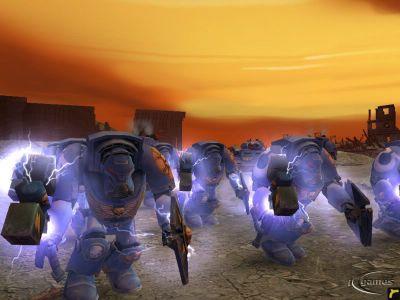
Terminators/Assault Terminators - infantry don't get much heavier than this. Good against all unit types. Won't get anywhere fast without transports or teleporters (upgrade).


Chaos - Space Marines gone wrong, plus daemons. Meaner in hand-to-hand, but more more expensive and less predictable (lower morale, daemonic units can dissolve or run amok, etc). Vulnerable to Imperial anti-Daemon and Faith-based abilities.

Uber-unit: Bloodthirster (melee only). One mean mother, and can fly to boot. Need to sacrifice one of your aspiring champions to summon him, but hey, what's another puny life in Warhammer 40000?

Leader Units -
Chaos Lord - The scythe ('manreaper') should tip you off on how to use this guy. Like Chaos troops in general, the emphasis is on damaging the enemy's health and morale rather than resilience.

Chaos Sorceror - Packs less punch than the Librarian, but ultimately has a wider range of spells. Needs upgrades to be really useful.


Orks - Big, bad, green. Vehicles are fast and good for short range bombardment but lack stopping power. Best race for close combat (power klaws). Can't aim straight and no armour to speak of, so you need lots of them, especially since morale rises with squad size. That's why they're cheap and quick to produce (orks have a unique unit cap system based on building waagh! banners). If your idea of strategy is to swamp the enemy with bloodthirsty slabs of meat, this is your army.

Leader Units:
Big-Mek - unusual array of support abilities, but also good for bone-breaking combat.

Warboss - like a small tank, but attacheable to squads. Can go one-on-one against pretty much anything. Both the Big-Mek and Warboss have powerful ranged weapons, giving these two an edge over other races' leader units.

Uber-unit: Squiggoth. Akin to those little critters they breed in the gretchin pits, only the size of a brontosaurus and decked out like Eben-Emael. Specials: Unbearable Roar (original, ain't it?) and Trample, which means scattering everything in a straight line like tenpins. Can transport infantry.


Eldar - Highly-specialised units with multiple abilities demand positional warfare (not the race for beginners). 'Fleet of foot' helps infantry to get around quickly, and you're gonna need it - Eldar squads can't take much punishment, even the close-combat ones. Need their bewildering array of upgrades if they're not to get their butts kicked off screen. Once they've climbed the tech tree, Eldar lay down the most short-range firepower of the game's races. Teleporting worker unit is very useful.

Leader Unit: Far Seer - just the one, but she makes up for it with a truly formidable array of pyshic abilities. Make sure you get eldritch storm, it blows away the opposition. The Seer Council is a combat squad of warlocks designed as escort for the Far Seer.

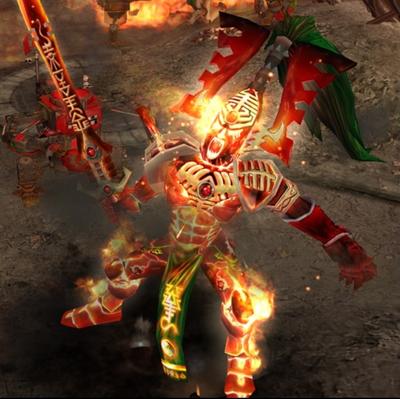
Uber-unit: Avatar (melee only). Choose Eldar just to watch this baby do a barbecue job on the opposition.


Imperial Guard - coming this month! Not many details yet, but in true IG style the emphasis will be on firepower and hordes of expendable grunts. If the Space Marines are the Emperor's rapier, the IG are his sledgehammer.

Padme is dead? NOOOOOOOOOOOOOOOOOOOOOO

Ultimately DOW fails to trump the competition because it's an emotional desert; it lacks the little frills that humanise Blizzard games, like window animations and comedic unit responses. Instead we get spectacular but depressingly severe scenery, impersonal units and effects that are intially breathtaking but soon wear out their novelty value. All said and done however, DOW is a fine game and infinitely superior to the other dismal attempts to date (like Playstation's Firewarrior) to transmute the 40K franchise into the virtual medium. Blizzard fans won't be converted, but it's too intense a ride to miss for any RTS gamer.

Friday, July 29, 2005

Kingdom of Fiction

This review is in the current issue of Farrago, the Melbourne Uni student magazine. In retrospect it's a bit hard on Sir Ridley - seeing the film with your Crusades history class (lecturer included) disposes you towards criticism. For formatting reasons I've replaced italics with bold text.

____________________________________

Making a film about the crusades against the backdrop of the War on Terror was always going to be a delicate business. That said, when scholars are lining up to blast the production as ‘complete rubbish’ and ‘Osama bin Laden’s version of history’ the director has clearly missed the mark. Ridley Scott got away with sacrificing history to entertainment in Gladiator because that film didn’t ask viewers to believe they were watching the real thing. Kingdom of Heaven does, parading a Hollywood plot construction as fact and inevitably offending a great many people given the sensitivity of the subject matter. Scott’s boasts of the film’s authenticity have only deepened the hole he has dug for himself by rewriting the past as a progressive political statement. To make things worse, he hasn’t made a very good movie.

Balian the blacksmith (Orlando Bloom) is the illegitimate son of a crusader who has struck it big in the Holy Land and is back in France to tie up loose ends. Having indiscreetly murdered the local priest, Balian is persuaded by his old man to start afresh in the crusader Kingdom of Jerusalem. For this is a ‘Kingdom of Conscience’, a utopian project in a world bound by chains of class and religion, where men are judged by character and not their background. Not that this matters for Balian, given that he inherits his father’s fief of Ibelin and starts an affair with the king’s sister. Nevertheless his ‘quality’ is recognised by everyone from Arab noblemen to the leprosy-afflicted King Baldwin, who on his deathbed offers Balian the throne to keep it from the clutches of Guy de Lusignan and his fanatic Knights Templar. Unfortunately Balian defers to the warmongering Guy, who proceeds to get Jerusalem’s army destroyed by the Muslims, leaving Balian in charge of the city’s defence against the legendary Saladin.

One gets the feeling that Scott devised this Middle Eastern Camelot less from conviction than from a desire to avoid his subject matter’s political minefields. Ironically the resulting revisionist schemozzle stumbles right into them, hence the barrage of criticism from Cambridge academics to internet bloggers, Muslim and non-Muslim alike. Even uninformed viewers are not likely to buy Scott’s pitch of the crusader states as an egalitarian and multicultural paradise, hammered home by shots of Arab children cavorting round Balian as he dirties his hands making the Palestinian desert bloom. Audiences are more likely to see a prescription for the region’s current politics rather than an accurate representation of the Kingdom of Jerusalem, which rested on a feudal-religious hierarchy with Latin Christians at the top and Muslims at the bottom. To prop up this historical hatchet job, Scott resorts to demonising a particular group; casting the Templars as vicious fundamentalists is both wrong and as convincing as any cardboard caricature of plot villains. The more Scott bloats up his artificial edifice, the more factual license he has to take: Balian becomes a virtuous plebeian and Sibylla a free-riding amazon, Guy and Reynauld morph into Templars, Baldwin gets an extra year of life so he can be around for the film’s events.

Such historical gymnastics reveal Scott’s misconception of the task facing him. It was impossible for such a movie to be both politically neutral and accurate, since the crusades and the responding jihad were fundamentally religious projects that directed violence against unbelievers. Scott makes some concessions to history, including wild-eyed clerics preaching the sanctity of killing Muslims and Saladin’s casual beheading of Christian prisoners, but ultimately he shies away from confronting his subject matter. The result is not just synthetic but cheapens the realities of cultural and sectarian hatred, which in today’s political context ought to get more serious treatment. If Scott wanted an alternative focus then he could have explored the manipulation of ideas for political ends, a theme for which the crusades offer plenty of material. This would have allowed for even-handed contemporary resonances, from uncritical Western assertions of ethical purity to exploitation of the crusades as a diversion from the failures of Arab states.

Politics aside, Scott approaches this film from the wrong technical angle. Put simply he chooses spectacle over verisimilitude, notwithstanding that the latter marks out good period drama. In Kingdom of Heaven, the dunes of the Moroccan desert substitute for coastal Palestine. Jerusalem is unrecognisable, sitting in a featureless plain with a non-existent mountain rising in its centre. Battle scenes fall back on the tired formula of incoherent masses and heedless charges, without even a rudimentary effort to show tactics. The central battle of Hattin is glossed over completely, in favour of vistas of Quranic war banners, an improbably gaudy True Cross and Saladin’s army engaged in the first all-Arabian derby. Jerusalem’s bombardment resembles the opening night of Operation Iraqi Freedom more than a credible twelfth-century siege.

It is hard to believe that the man who directed Alien and Bladerunner accepted a script as flat as this one. All the characters are two-dimensional, excepting perhaps Balian’s short-lived father (Liam Neeson) and the withered King Baldwin. Balian’s character leaps full-fledged into the film, leaving Orlando Bloom with nothing to do but look rugged and show off his sword fighting skills. Even Saladin is reduced to a quasi-orientalist portrayal, passing up the chance to explore the complexities of this brilliant Kurdish warrior statesman. Indifferent characters can be carried by a strong story, but plot defects abound in Kingdom of Heaven. The film’s linearity suffers from unexplained scene cutting: one moment Balian is leading a refugee column out of Jerusalem, the next he’s back in France working as a blacksmith. Bizarre plot devices further erode the narrative’s credibility. Why is a Syrian aristocrat cross-dressing with his servant and pledging himself as Balian’s slave? Why does Balian prepare for assassins by sitting alone with no weapon outside his castle walls?

Because Kingdom of Heaven doesn’t quite work as a film, it comes across as a gratuitous political exercise. The very title should put viewers on guard as to the film’s authenticity. It is not void of redeeming qualities; Scott’s sense for colour and lighting remains exquisite, while the leper-king Baldwin evokes genuine pathos. But it fails dismally at the challenge of making history into entertainment.

Sunday, July 24, 2005

Galactica Gothic


'Middle Ages in space' doesn't do justice to Warhammer 40000, which draws on elements across the tapestry of western history to create a dystopian but many-layered future universe. Where Warhammer was confined by its late medieval setting, 40K gets to indulge a smorgasboard of historical flavours - Imperial Rome, Victorian England, 20th century fascism - while keeping Elves, Orcs and other medieval fantasy staples, only adding spaceships and guns. Hardcore science-fiction buffs may sniff at such quarrying of the past as intellectually lazy and tacky, but it’s their loss.

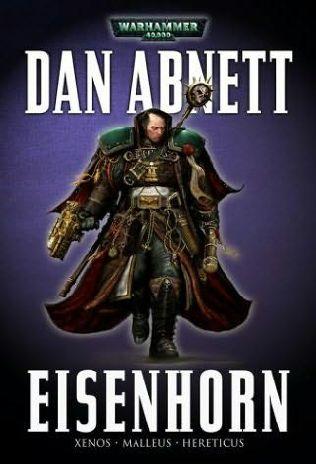
It’s their descriptive opulence in exploring this dark future that makes the Eisenhorn novels worth the read. In contrast to his Gaunt’s Ghosts series, which can qualify at a pinch as military fiction, Dan Abnett's trilogy of the plucky Inquisitor can’t aspire to the detective genre. He gives us a sequence of events rather than well-defined plot lines leading to a resolution, admittedly a criticism that could be applied to many Sherlock Holmes stories. The trick is that the reader doesn’t notice because he (more occasionally, she) is absorbed with the events themselves and the backdrop against which they take place. As Abnett acknowledges in the preface to the one volume edition, the idea was to give readers an insight into the texture of the 40K universe, so often sublimated into the pervasive violence associated with Games Workshop. The ‘storyline’ is Eisenhorn’s self-narrated personal journey, which is used to showcase the 40K universe and serve as a metaphor for its moral paradoxes, with liberal doses of bloodshed, psychokinesis and daemonancy thrown in along the way.

An Inquisitor was the obvious choice for this role, not just because he gets to travel but because the Inquisition is the Imperial institution par excellence, its raison d’etre being to root out difference within Imperial society and burn it – sometimes literally – in the name of species survival. The first paradox is obvious: to save humanity one has to crush it, in spirit and often in flesh. The second is more subtle: to fight the darkness one must flirt with it, a dilemma Abnett works out primarily through the daemon Cherubael, who despite being more a device than a character and warp spawn to boot is one of the Black Library’s more memorable creations. The implications of this ethical impasse aren’t pretty. Everything Eisenhorn is attached to as a human being (even his own body) is progressively destroyed, leaving him stalking the shadows alone, or more precisely with an imprisoned daemon for company. The God-Emperor’s work is a hard calling.

As expected of a 40K novel, Eisenhorn is not a light read. Occasional scenes of poetic charm and even beauty relieve a sea of grimness, in which most characters eventually die with varying degrees of unpleasantness. It seems to be the First Law of Science Fiction – the more dystopian the universe, the more readers relate to people living in it – and Abnett, who’s perhaps better known for his work on the 2000AD (Judge Dredd) franchise, is an old hand at this. I can’t think of a novel that better captures the baroque and sometimes frankly disturbing appeal of Warhammer 40000.