Showing posts with label Culture Wars. Show all posts

Saturday, September 23, 2006

The Book of Jihad (no, it's not the Koran)

Update

What inspires people to stick up political rants on low-traffic blogs with no relation to or sympathy for the subject matter? It's happened to me, and now to a friend who unwarily used the phrase 'Pope and Islam' in a post title. At least my guy had a case to make about discrimination in Malaysia, even if he did it on a post about our club barbecue. Jeremy's visitor managed to mention the Pope, but only once amidst the screeching about oil independence from "Islamonazis" (are those like "commie-nazis"?).

Flatten the world, and you get the lowest common denominator...


Update 2


See what I mean?
_________________________

Ever since the Pope put Islam and violence together, the media has been awash with religious men commenting on what other religius men had to say about other religions. Some, like the Anglican vicar given a 2500-word column in today's Australian, have some interesting points to make. The only one I'd take issue with is his (unsubstantiated) assertion that the medieval Catholic doctrine of holy war derived from jihad. Cultures are quite capable of cooking up fanatical ideas independently, as I hope comes across in this piece dashed off for my Crusades subject a couple of years ago.

Personally I'm more interested in what al-Sulami had to say about the Franks - an 'existential threat' to society from within, against which people have to be roused from complacency to defend themselves, and with whom no compromise is possible. Now where have I heard that before?...

________________


Al-Sulami’s Kitab al-Jihad ('Book of Jihad') is the first extant call for a Muslim military response to the Crusades. Delivered as an oral sermon in the Great Mosque at Damascus six years after Jerusalem’s capture by the Franks, its’ immediate context is the establishment of the Crusader states in the face of the Muslim world’s continued apathy. The Kitab al-Jihad is therefore a key text for study of the evolution of Islamic responses to the Crusades, although its value to the historian is vitiated by the fact that its two surviving manuscripts are incomplete. More specifically, al-Sulami’s qualifications as a religious scholar make his text valuable to understanding the construction of the Islamic ‘holy war’ concept; to this end, it provides more insights than the accounts of Arab historians or political leaders more familiar to historians of the Crusades.

The Kitab al-Jihad is clearly intended to mobilise a pan-Islamic military campaign against the Franks. Al-Sulami draws his listeners’ attention to the invasion and occupation of Islamic territory, and exhorts them to express Muslim solidarity through an armed response; his Damascene audience is told that the Franks’ assault on Palestine and the cities of the Mediterranean coast constitutes an ‘attack on your country’, and that a counteroffensive is a matter of the ‘defence of yourselves and others of your brotherhood’. While certain references in the text indicate that al-Sulami’s message was delivered to a high-ranking audience - men with the authority and resources to mobilise the country for war – it is addressed to Muslims as a community, in the same sense that Pope Urban’s sermon at Clermont was preached to a noble audience but addressed to Latin Christendom. Al-Sulami cites Islamic history and the hadith (sayings attributed to the Prophet Mohammed) to demonstrate that jihad is the collective duty of all the faithful. This goes against the then-prevalent view of the Frankish intrusion as a regional affair, a matter concerning the local emirs or at most the Seljuk rulers. Al-Sulami’s rebuke to his audience for continuing to rebel against their punishment may be a direct reference to the absence at that time of any substantial Muslim response to the fall of Jerusalem.

Indeed, al-Sulami’s emphasis on a collective Muslim duty to fight the Crusaders stems from his perception of this phenomenon’s peculiar nature. To him it represents no ordinary trial, but ‘a punishment the like of which [God] did not warn you [Muslims] with before … a matter of serious vengeance, destructive extermination and removal’. Allowing for rhetorical hyperbole, this message still contrasts sharply with other contemporary Muslim writers’ characterisation of Frankish aggression as mere banditry or revenge-seeking. Al-Sulami was apparently alone among his contemporaries in recognising that the Franks were waging a religious war against Islam. He actually uses the Arabic term jihad to describe the Crusaders’ behaviour. They are not a passing menace, but a fundamental threat to the integrity of the Muslim world that must expunged by armed force.

Al-Sulami’s analysis is significant not only for its novelty and perceptiveness, but for its implications for Muslim behaviour towards the Franks. At the turn of the 12th century the Muslim Levant was a political patchwork created by the erosion of Seljuk authority. The wider Islamic world seems initially to have been prepared to accept the Franks as a new element in this mix, albeit a novel and unusually violent one. Christians had after all coexisted with Muslims for centuries in the Holy Land (though in a subordinate position and forbidden to bear arms). It is only once the Franks are constructed as a religious aggressor that expelling them becomes imperative. Al-Sulami brands them as ‘enemies of God’ and ‘blasphemers’, thus elevating them from ignorant savages into active enemies of the Faith, who cannot be bargained with or simply ignored. Our knowledge of the evolution of Frankish-Muslim relations would be further improved if we could study how al-Sulami developed views so distinct from those of his contemporaries, but we are unfortunately ignorant of his sources of information.

Having constructed the Frankish presence as a matter of holy war, al-Sulami’s sermon is necessarily underpinned by a religious theme. The Crusaders are a ‘warning from God’, a punishment for Muslim sin and complacency. At the same time they represent a test, a chance to repent by obeying God’s rulings as set out in the Qur’an – specifically by conducting jihad against the Crusaders. However, waging war against the infidel is not in itself enough; if one does not ‘desire God’s face’ by an act then it is hypocritical, and impliedly no better than the behaviour which attracted divine wrath in the first place. Therefore practice of the internal jihad – ‘rooting out’ bad qualities, submitting oneself to God’s will – is a prerequisite for success in the external jihad against the Franks. The spiritual state of the individual jihadists will determine whether God grants victory or whether ‘He will make you fall into the hands of your enemy’.

There are repeated and striking parallels between this elaboration of holy war and the Crusading idea preached by contemporary Popes: the attribution of catastrophe to divine judgment, the calls for religious solidarity, the emphasis on personal piety as integral to the military endeavour. These similarities become more intriguing when one considers that the concepts of jihad and crusade developed independently of each other. It is highly unlikely that al-Sulami was familiar with the content of Pope Urban’s sermon at Clermont, if he knew of it at all; conversely the Crusaders (initially, at least) knew nothing of the centuries-old Muslim doctrine of jihad. The kitab al-jihad provides a useful basis for a comparative study of the two holy war traditions, aiding critical analysis of their main features.

Take for instance the common approach of caricaturing the enemy, whether by railing at the ‘great tyranny’ of the Franks or by conjuring images of Turks defiling Christian altars and murdering Christian babiess. Another means of dehumanising the religious foe is by stripping them of autonomous motives or capacities: ‘(the Franks) acted as they did because of (you Muslims’) blame of God’ (sic), and it is God who ‘increases them in great tyranny’ (i.e. gives them victory). Portraying the enemy as nothing more than an instrument of God’s chastisement undermines attempts to understand or interact with them as fellow human beings. The fact that such interaction did occur – take for instance the arrangements reached between the Templars and various Muslim factions, or the chivalrous exchanges between Richard I and Saladin – highlights a gap between the theory and practice of holy war that is easy to overlook from a 21st century viewpoint.

Comparative analysis is also useful for placing religiously-defined war within its sociopolitical context. Al-Sulami’s message went unheeded for over a decade; it produced .no fruit until it encountered fertile political ground, specifically when Muslim rulers (Zengi, Nur ad-Din, Saladin) found jihad a useful concept to support empire-building agendas. This is not to deny that these leaders may have been motivated by genuine religious conviction, but the timing does provide insights into the influence of extra-religious factors on the practice of ‘holy war’. At first glance, the immediate and dramatic response to the Clermont sermon might seem to be a contrasting experience. However, by drawing attention to the sociopolitical context of late 11th century Western Europe – overpopulation, a drive to expand Papal influence, the closing of domestic outlets for knightly aggression – al-Sulami’s example helps us appreciate the role of these extrinsic factors in the crusading concept’s development.

Comparative analysis does show up some differences between Christian and Muslim holy war traditions. For instance al-Sulami uses the image of ‘sleep’ to rebuke his Muslim audience, whereas papal criticisms of Latin Christendom’s were generally focused on its internecine warfare. Another point to note is that al-Sulami’s God is a more prominent and vengeful character than the deity featuring in crusading sermons. The differences are however certainly less remarkable than the similarities. As one writer has observed, the great value of al-Sulami’s text is that it shows how certain basic ideas associated with holy war were common to medieval Christendom and Islam, so often considered alien cultures in the context of crusades studies.

Sunday, September 17, 2006

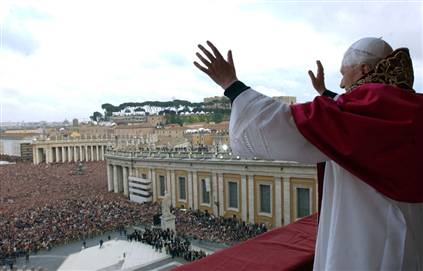
Pontifex Tactlessness


The latest uproar over a perceived slight to Islam isn't going quietly into the night. One week on it's spawned its own wikipedia entry, a slew of rants throughout the wingnut blogosphere and obssessive mainstream media coverage. A speedy resolution hasn't been helped by Muslims round the the world again deciding that the appropriate response to barbs about their faith's peacefulness is to bomb churches and issue death threats.

Nor by the fact that this time the offending observations came not from a Danish newspaper but rather the head of the Catholic Church, albeit wrapped in a theology lecture (full text here). It's unfortunate that the Pope couldn't make a point about faith and reason without a reference to jihad. And he couldn't even do that without quoting that bosom buddy of medieval Catholicism, the Byzantine emperor -

Naturally the emperor also knew the instructions, developed later and recorded in the Qur'an, concerning holy war... [he] addresses his interlocutor with a startling brusqueness on the central question about the relationship between religion and violence in general, saying: "Show me just what Mohammed brought that was new, and there you will find things only evil and inhuman, such as his command to spread by the sword the faith he preached". The emperor, after having expressed himself so forcefully, goes on to explain in detail the reasons why spreading the faith through violence is something unreasonable.

The decisive statement in this argument against violent conversion is this: not to act in accordance with reason is contrary to God's nature... But for Muslim teaching, God is absolutely transcendent. His will is not bound up with any of our categories, even that of rationality.

This passage amounts to the following claims: a) spreading faith through violence is irrational; b) Islam teaches violent conversion; c) Islam teaches an irrational approach to faith. The Pope's speech has to be read as tacit endorsement of all these propositions. You don't use quotes to illustrate a point unless you believe the quotes to be true in substance, even if you find their expression 'startlingly brusque'. And you can't seal yourself off from controversial assertions by putting them in the mouths of medieval monarchs, or by protesting that the statements were tangential to your main point.

The issue here is not whether the claims about Islam are true. The Pope is an official figure and as such doesn't have the freedom that he enjoyed as Joseph Ratzinger, Professor of Theology, to comment on the teachings of other religions. He has the right to say what he wants, but also responsibility for the consequences, especially when pointed observations about the religion in question have a history of generating violence. This isn't 'political correctness', it's political common sense. The pontiff can no more wash his hands of this than politicians who accuse foreigners of stealing jobs can divorce themselves from a xenophobic backlash in the electorate.

Pope Benedict would have done better citing the example rather than the ideas of the said Byzantine emperor. Manuel II may have argued that Islam is disposed to violence, but he and his Muslim interlocutor were debating the issue with words rather than swords (not that Manuel had much choice, at a time when the Turks were tightening the noose round his beleagured 'empire'). One might have expected some progress on interfaith relations over the intervening six centuries. Instead they seem to be heading back to an era captured by the opening scene of Alan Savage's Ottoman, in which Manuel II's son is presented with the severed, uncircumcised penis of a Hungarian knight as proof of the fate of the last crusade.


Postscript


For firebreathing secularists, the natural response to this sort of thing is a pox-on-both-your-houses. I stick by my angle: the trouble isn't with religion per se, but with trying simultaneously to be a theologian and a politician.


Sunday, August 27, 2006

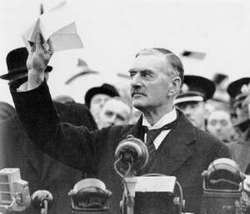
'A' is for Appeasement - and Absurd Analogies


For a paper that champions the integrity of history-teaching, The Australian plays fast with the past. Last Monday, the Age published a long-overdue piece on how the War on Terror has sent abuse of historical analogies into overdrive. Right on cue, the Oz devoted nearly 1200 words in its Friday editorial to tarring former ambassador to Israel Ross Burns as a new Chamberlain, eager to sacrifice Israel to "anti-semitic fascists" for the sake of Indonesian goodwill. It joins a long list of right-leaning broadsheets competing to prove that Godwin's Law applies to the print media as well as the internet.

So why is thinking twice about bombing Muslim populations equivalent to offering up Czechoskolovakia on a plate? You wouldn't know from the Oz editorial, which seesaws from the usual waffle about 'appeasement' to Iran's nuclear program and then back to the Nazis. Like them, Iran and its Hezbollah clients hate Jews and preach violence, so our response must be the same. Never mind that the Hitlerite threat was confined to a nation-state and its military assets, while the Islamist one spreads like a virus through neutral populations. We know there's no room for moral ambiguity or tactical subtlety with either, because they both won support from - wait for it - 'progressives', 'elites' and 'the Left', or so The Australian tells us.

And we haven't even got to Mr Burns' argument, supposedly the subject of the editorial. It's hard to make out amidst the ad honimem attacks beloved of the Murdoch press (apparently Mr Burns' diplomatic career has been "undistinguished", so we needn't respect his opinions). You might wonder why this paper's editors think they can convince readers that they're more qualified to analyse Middle East politics than a man who was ambassador to both Syria and Israel, until you realise you're not supposed to think when reading it. But since the Oz is such a fan of telling the past As It Was, let's have a look at what Mr Burns actually said on the 7:30 report -

'it's been a very common and most prominent theme in government responses for some years now... the first reaction is to say, "Well, doesn't this represent Israel's legitimate right to defend itself?" When I think there are many other complexities in the situation.'
'[There] should be more to our policy than just simply one of uncritical defence of Israel... we 're only emphasising a very small range of points, most of which are very much echoing points made by Israeli politicians and they don't see us as trying to maintain a more balanced attitude to a crisis...'
'...the Indonesians are not necessarily going to be impressed that we have such an uncritical attitude towards Israel and... in particular, at the very great challenge to the future viability of Lebanon, which has been posed by events in recent weeks.'

'the debate is impoverished... it's getting to a point now where our whole standing in the wider context of the Middle East, including the Arab world, is starting to suffer... we identify with one side and that stops us being able to play a more constructive role when and hopefully if such a context develops in the future.'

Ah, now I see how Burns is "offering up Israel to Hezbollah"; how he wants to see "Australia turn its back on a Kadima government"; how he's really trying to aid the terrorists.

How blind I was...


Update


Ross Burns' character assassination has been drowned out by the hysteria over 'Jihad Jack' Thomas, with our favourite right-wing rag again leading the charge.

Meanwhile, the Herald Sun has revived another cause celebre of local 'conservatives' - valourising the two pastors panned for preaching a Muslim conspiracy to take over Australia, by completely misrepresenting what they (and the judge who ruled against them) said. You can listen to Andrew Bolt, or if you're the thinking type, you can read this dissection by a friend of mine over at Boltwatch.

Tuesday, April 25, 2006

ANZAC Day, Australia Day


Update 26 April

The lynchmob has been out these two days for Steve Barton and his effort to debunk the claim that Kokoda was 'the battle that saved Australia'. Barton's certainly dug pits for himself with his rant about an ALP agenda and other gratuitous political grenades - e.g. that a Japanese occupation of Queensland would have been tolerable (in view of ultimate allied victory), or that the diggers in New Guinea weren't fighting in defence of Australia's liberty. But the heat his basic argument has received does suggest that the 'ANZAC legend' has become a sacred cow in Australian cultural life.

See these threads at Larvatus Prodeo and John Quiggin.

_________________________________________________

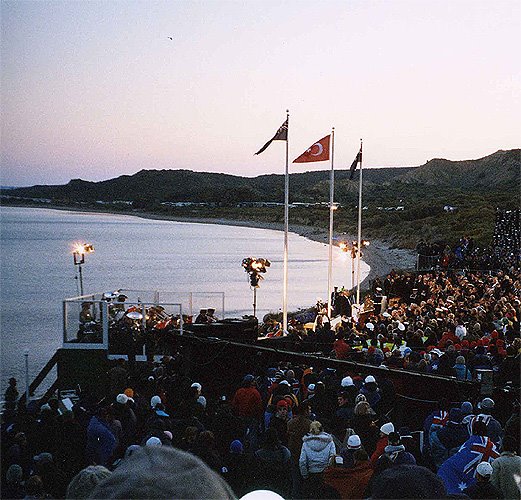
ANZAC Day, as the media constantly reminds us, is the closest to a national day that Australia gets. The salience of overseas military endeavours and Gallipoli in particular in our national mythology is unique, and quite beyond the imaginings of the young men who stormed ashore at the Dardanelles a hundred-plus years ago looking for the 'soft underbelly' of the Central Powers. They didn't find it, but a lot of men died in the process, on which point it's worth noting that Australian dead were outnumbered by Brits (2:1) and even 'Frenchmen' (i.e. conscripted Algerians), not to mention Ottoman troops (10:1).

It appears that this wastage of human life is what most impresses those who make the Gallipoli pilgrimage, or indeed anyone who tries genuinely to tap the spiritual significance of the ANZAC heritage (as opposed to just using it for beating up on ethnics). Claims that ANZAC Day 'glorifies war' are reductionist and distract from more pertinent critiques of its cultural symbolism. One is that it indulges Australian chauvinism, most obviously by asserting an Australian monopoly on such virtues as self-sacrifice and 'mateship' through the vehicle of the ANZAC soldier. On the other hand, there is growing recognition of the other side's story in any given conflict; with Gallipoli for example it's now common - more so among ordinary folks than politicians - to discuss the Turkish contribution and in particular that of Mustafa Kemal (Ataturk), one of history's underrated statesmen.

Another stock complaint is that Australian military commemoration sets up a 'hierarchy of sacrifice', a constant bugbear for veterans of less popular conflicts: Korea, Vietnam, the postwar occupation of Japan. But most significant is the charge that ANZAC remembrance has become an anachronistic touchstone of national identity.

My sense is that Anzac Day has grown in appeal in inverse proportion to confidence about our common identity, future prosperity and national security.

History ... perpetuates collective self-awareness. The Anzac legend offers a comfortably prescriptive notion of who we once were.


The irony here is that Gallipoli marked a break in Australian self-awareness, not immediate but fundamental: the end of Empire and the sense of a separate nation making its own way in the world. Arguably this would have occurred without the experience of having the flower of the country's youth sacrificed on the map-tables of Whitehall, but that's what happened and, as they say, the rest is history. The contemporary issue is whether the ANZAC legacy can be converted into a tradition of general service to the world community, as attempted by today's Australian editorial, or will become the foundation of an oppositional and exclusivist definition of Australian identity.

It can't be coincidence that the swelling youth interest in ANZAC history has occured against a backdrop of globalisation, the growing prominence of 'Asia' and (more recently) a political discourse of clashing civilisations. One can argue over what role the Howard government's promotion of an authentic and monistic national identity has played, but on one point the Prime Minister is definitely wrong. The ANZAC story, like the broader Australian one, is not a closed book but a work in progress.

Wednesday, March 01, 2006

The Mush of Multiculturalism


Tony Abbott's gaffe about the ALP's affirmative action policy (branch-stacking) has taken a little wind out of his stand on multiculturalism. Still, one shouldn't confuse a person's integrity with the validity of their argument:

"I do not find sharia law, as I understand it, to be particularly appealing but I think that people are perfectly entitled to make a case for anything that is not inconsistent with the law of this land," [Abbott] said.

Whether shari'a is compatible with our constitutional system can be debated, but the principle is sound. As a tactical approach towards Islamic extremism, I'm prepared to back communal dialogue over assimilate-or-be-ostracised; could it be that we hear so little from moderate Muslims because we leave them no space to talk in? But more importantly, Tony's got the basics right.

An Australian citizen has one obligation: to obey the laws of this country. He or she doesn't have to subscribe to an amorphous set of 'Australian values' laid down by politicians or a particular understanding of Australian history. To quote He-of-the-Magnificent-Ears, citizens should not be subjected to a "test of Australian-ness". If they want to wear the burqa or believe that European settlers committed genocide against aborigines, that's their business and not society's concern.

That's why the 'un-Australian' rhetoric that's slipped into political jargon is so pernicious. The great strength of liberal democracies is their capacity to accommodcate diverse groups under the rule of law, without imposing an elite or majoritarian idea of truth. That's what multiculturalism means - accepting any individual who's prepared to be a functioning member of the body politic, without requiring them to otherwise conform. That's why Abbott is right and Costello wrong. Multiculturalism is not 'misguided', it's fundamentally in tune with the classical liberal principles that this country was built on.

There's much talk right now about the formula that's made John Howard the most popular Australian PM of the modern era (which is to say most popular, since most people can't name any before Menzies). If you had to boil it down to a phrase, it'd be 'identity politics'. Howard has weathered a series of crises plus several rounds of unpopular legislation, and come out ever stronger, because he's managed to identify himself and his party with the worldview of a majority of the population. Lately this has meant constantly referencing a core of innate 'Australian values' around which membership of Australian society must be based.

In other words, Howard has established a cultural creed - that of 'middle Australia,' 'battling Australia ' and the other constituencies on which the Liberal ascendancy rests - as the basis of national politics. After ten years, this approach is running up against the acultural lines on which our constitutional system is organised. It began with post-Keating assertions of 'national character', gained momentum with the asylum seeker battles at the turn of the century and has come to full bloom with society's handling of the 'Muslim problem' post-9/11.

Societies throughout history have achieved cohesion by imposing a given moral and cultural order. But liberal democracies don't, and that's what sets them apart. They endure, and prosper, because people are left alone within the framework set by law and elected government. Just remember that the next tine you hear a call for indoctrination with 'Australian values' or an end to 'mushy multiculturalism'.

Wednesday, February 08, 2006

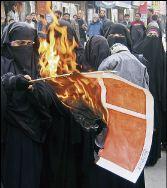
Cartoon violence


The mainstream media rarely cedes limelight to a blogger, but Tim Blair's decision to publish those infamous cartoons satirising the Prophet Mohammed has made him hot property. While other desktop pundits have published the offending pictures, it's Tim's name that's popped up everywhere from the Sydney Morning Herald to Triple-M talkbalk radio. I'm not suggesting he did it for fame - to the contrary, I'm fairly sure Tim did it as a matter of principle. Which is the problem.

As with every post-9/11 newsbit involving violence and Muslims, the right has seized on these doodles to kick Islam in general. Before we heard a peep from Australia's Muslim community, the cartoons were being used by non-Muslim bloggers to stoke a sense of 'Us vs Them', reinforcing the false Western-Muslim paradigm that's fastened like a leech to the War on Terror. In his post Tim Blair labeled a Muslim leader's request for non-publication as "orders" to the non-Muslim population, and praised the Danish publisher of the cartoons as "taking one for the (non-Muslim) team". Others have claimed that a failure to publish amounts to cowardice and capitulation to the Muslim (not terrorist) menace.

The Jyllands-Posten commissioned the cartoons to promote debate about the violent reaction among Muslims to criticism of Islam; or so it claims. What it actually did was call for Danish cartoonists to portray Muhammad "as they see him" - effectively an invitation to make blanket statements about Islam, with no link to the original issue of self-censorship in the Danish media. This is exactly what the 4th, 6th, 10th and 11th cartoons (and arguably some of the others) do, following the top-down order of publication at Wikipedia. It was deliberate shit-stirring from the outset, so it's no surprise the pictures have been used for this purpose by Islamophobes the world over.

Whether Islam fosters violence, oppresses women etc are all subjects for debate under the right to free speech on which liberal democracies are founded. But these cartoons don't promote debate; their sole effect is to evoke fear and revulsion in the viewer. They come close to the kind of behaviour that got Catch the Fire Ministries (CFM) a court order under Victoria's anti-vilification legislation, pertinent extracts of which follow.

(8) A person must not, on the grounds of religious belief or activity of another person or class of persons engage in conduct that incites hatred against, serious contempt for, or revulsion or severe ridicule of, that other person or class of persons.
(11) A person does not contravene section 8 if the person establishes that the person’s conduct was engaged in reasonably and in good faith -
    (a) In the performance exhibition or distribution of an artistic work; or
    (b) In the course of any statement, publication, discussion or debate made or held, or any other conduct engaged in, for -
      (i) any genuine academic, artistic, religious or scientific purpose; or
      (ii) any purpose that is in the public interest; or
    (c) In making or publishing a fair and accurate report of any event or matter of public interest.
What nailed CFM was their claim - without supporting evidence - that Australia's Muslim community as a whole is conspiring to take over the country, with the ultimate goal of forcing conversion to Islam upon the wider population. It was CFM's design to stoke hostility towards a given community regardless of facts, in the same way that Islamic governments use the Protocols of the Elders of Zion to demonise Jews.

Whether this sort of thing should be banned by law is up for debate (see the CFM link above for starters). But it's certainly undesirable, and politicians are right to condemn it and editors to refuse publication. The Mohammed cartoons lack the deliberate falsities featured in the CFM sermon, but they still sail pretty close to any definition of hate-speech one cares to use. They impose guilt by proxy, targeting all Muslims by pandering to the non-Muslim viewer's tribal instinct. How is this different from 19th-century cartoons portraying the Chinese as slant-eyed degenerates poised to overrun Australia (and *gasp* cavort with white women)?

In the present political context, these sad little pictures are headier stuff than depictions of Jesus submerged in urine or having sex with Mary Magdalene. Publication should be allowed, but promoting them isn't socially responsible and those who choose not to can ignore charges of abetting the downfall of Western Civilisation. Or worse, being Un-Australian.

Thursday, January 26, 2006

Advance Australia Fair


(c) Nationalvanguard.org


Update
This post has been linked in the Crikey.com newsletter. Under Top Stories (12).
______________________________________


I'd hoped to get through Australia Day unscathed by the Culture Wars, but had to duck as soon as I opened this morning's Age. The front page carried John Howard's call for an overhaul of school history curricula, to replace multiculturalist relativism with a narrative celebrating "the great and enduring heritage of Western civilisation." The op-ed page featured left-wing boilerpate disparaging Australia's "infantile" national symbols and listing the country's various sins, notably indigenous disadvantage and asylum seekers.

Australia Day commemorates the arrival of the First Fleet rather than Federation (which inconveniently falls on January 1); in American terms it's closer to Columbus Day than to the Fourth of July. Australia Day is thus a focus for battles over national identity and its historical roots that Independence Day in the US is usually spared. The PM has taken this to a new level with today's 'This Is Who We Are' speech, which lays out the cultural bedrock of Howard's Australia - Judeo-Christian ethics, British heritage and commitment to racial equality. Apparently "the divisive, phoney debate about national identity... has been finally laid to rest".

The falsity of this statement is evident from Howard's own efforts to tiptoe round last month's race riots in Cronulla, which even this "One People, One Destiny" speech can't escape. Or the more recent debate over the freedom of SriLankan-Australians to barrack for Sri Lanka at cricket matches on Australian turf. Or the ongoing academic battles over racism and white-indigenous relations in Australian history. Our national identity is not a finished achievement but a work in progress, with plenty of social minefields along the way.

Encroaching on these minefields is the swelling balloon of patriotism, most visible in growing public use of the flag and interest in the ANZAC heritage among young people. There's nothing wrong with the Gallipoli pilgrimage at a personal level, but making it a touchstone of national identity is another matter. The concept that this construction of 'Australianness' presents problems for some Australians - that the Cronulla rioters' exclusive claim to the title 'Sons of Anzacs' may have some broad social significance - seems to lie beyond the PM's mental horizon. Much easier to dismiss such problems as the fantasies of a chattering cognoscenti.

Howard's claimed victory in the identity wars is not a reversion to the country's 'natural' state. Like the conservative revolution in America, Australia's rightward drift is the result of deliberate effort led from the top of the political system. Howard came to power vowing to dismantle the cultural legacy of the Hawke-Keating years, which he summed up as excessive orientation towards Asia and away from traditional understandings of Australian history. In other words Howard had a retrograde social agenda, which has been prosecuted through diatribes against 'black-armband history,' back-peddling on reconciliation, slapping flag-flying conditions on school funding grants, establishing National Flag Day, legislative attempts to freeze the flag in its current form, assaults on 'leftist' and 'postmodernist' education bureaucracies, axing the NALSAS program etc. Then there are the more subtle processes, like the rise of racial wedge politics or the entry of the phrase 'Un-Australian' into public discourse.

These trends are not the expression of a single 'true' Australia. They are the imposition of a particular view of Australia through the avenues of power. Needless to say the political left is guilty of the same sin, but since 1996 the boot has been on the other foot. In this context we ought to keep a critical eye on the blooming of Australian 'patriotism,' in case it evolves into something much narrower and socially harmful. The ominous fact that flag sales have quadrupled since September 11, which can only express a mental closing to the outside world, bolsters my apprehension from those first pictures from Cronulla: that the flag and what it symbolises is being appropriated as a tribal badge, rather than the prerogative of everyone who swears allegiance to the Australian Commonwealth - regardless of whether they're white, identify with Gallipoli or adhere to a Judeo-Christian belief system.

Beware log-cabin patriotism. Or assumptions that a harmonious, multiethnic Australia is a finished achievement...

Monday, December 12, 2005

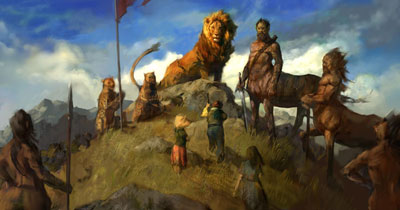
Out of the closet: the dark side of Narnia


Making film lines out of classic fantasy cycles is becoming de rigeur in Hollywood. Disney's version of The Lion, the Witch and the Wardrobe premiers on Boxing Day, and if it works may be the first instalment in a run of movies based on C. S. Lewis' famous novels. But nothing escapes the Culture Wars these days, and a battle is raging on this side of the wardrobe over Narnia's Christian theology and reactionary social values. The US-based Catholic Outreach has organised a nationwide network to promote the film, while the National Association of Evangelicals has given the production its imprimatur as a tool for, well, evangelising. On the other side of the lists, the progressive intelligentsia has been queuing to condemn it as as "propaganda in the service of a life-hating ideology" (i.e. Christianity), not to mention "the misogyny, the racism, the sado-masochistic relish for violence that permeates the whole [Narnian] cycle."

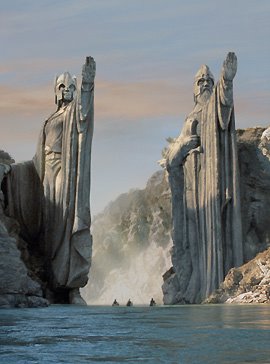
If there's a flavour of deja vu here, it's because the Rings trilogy provoked similar controversy a few years ago, mainstreaming debates about Tolkien's politics that have smouldered for half a century. Like that of Lewis, Tolkien's creation has a recognisably Christian theological framework and is replete with affronts to the postmodern conscience. A master race which declines as their blood mingles with that of 'lesser men', a virtuous West under assault from Eastern hordes (and southern, = Muslim), stilted and objectifying portrayals of women, the list goes on. Political attacks on The Lord of the Rings invariably shade into sniping at its literary merits, with critics from Edmund Wilson to Germaine Greer laying into the book for every sin from retrograde premodernism to frivolous escapism. It seems that Tolkien and Lewis peddle 'juvenile trash', but trash that's strong enough to indoctrinate children with a regressive belief system.

Bad guy


Good guy


All this reveals more about our own civilisation than that of Narnia or Middle Earth. Tolkien's and Lewis' detractors have created the perfect storm in-a-teacup, further cementing the image of progressive intellectuals as short-fused elitists. Likewise, one wonders about the state of Christian ministry when a Disney sword-and-sorcery epic is pressed into service for proselytising. By the same logic congregations should be briefed on Harry Potter, on a 'know-thine-enemy' basis (something that has in fact happened in many evangelical churches). We're hardly fit to condemn Narnia when we've created a society that doesn't leave enough neutral space to read kids a story about fauns and talking animals, and enjoy it as simply a story.

Because, of course, that's what it is. The genre is called 'fantasy' for a reason. Not every work of fiction is a more subliminal version of Animal Farm; some people write for the love of the art, of the creative process. That's why I used to write (before I discovered blogging), a hobby in which I drew much inspiration from childhood readings of Lewis and Tolkien. In any case both authors draw too extensively on pagan references, and are far too creative, for their work to be mere Christian allegory - a characterisation they strongly disclaimed. Lewis desccribed his work as 'suppositional' rather than allegorical:

"If Aslan represented the immaterial Deity in the same way in which Giant Despair represents despair, he would be an allegorical figure. In reality however he is an invention giving an imaginary answer to the question, 'What might Christ become like, if there really were a world like Narnia and He chose to be incarnate and die and rise again in that world as He actually has done in ours?' This is not allegory at all."

Likewise Tolkien, who was perenially irritated by people's efforts to find direct representation in The Lord of the Rings ("To ask if the orcs are communists is to me as sensible as asking if communists are orcs"), preferred to speak of 'applicability' rather than allegory when discussing his creation. He and Lewis were story-tellers foremost, Tolkien having authored a distinguished paper on the subject. Both, however, believed that creative fiction should allow the reader to find points of connection with their own reality. The Lord of the Rings is a tapestry from which one can spin what one desires: greenies indulge themselves in luddism and talking trees, counterculturists take inspiration from the triumph of little people over abstract powers, atavists savour strains of Teutonic mythology. Or one can just appreciate it as the heroic epic that Tolkien wrote it to be. This is different from 'propaganda', which is designed to influence the consumer's opinions.

Wagner, anyone?


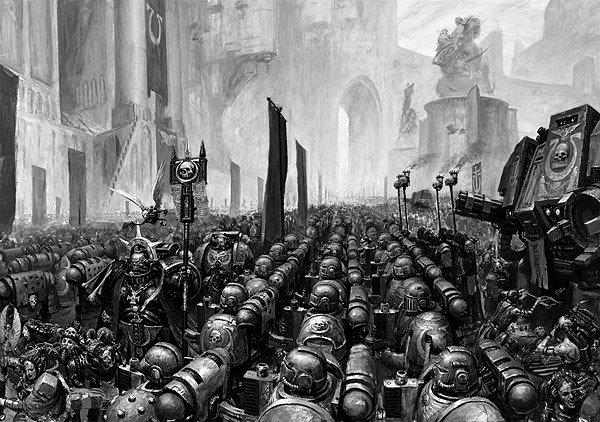
Where creative fiction is concerned, we ought to defer to the reader's maturity; after all, it has a great deal less potential for harm than many other things we entrust to the everyperson's faculties in a liberal democracy (free speech, voting franchise etc). Otherwise where do we hold the censor's blade? We'd have to cut Bunyan for proselytising, Scott and Dickens for anti-semitism, Defoe for stereotyping native americans. In fact we'd have to condemn literature from any time and culture other than our own, along with a large chunk of contemporary science fiction. From a western liberal viewpoint one can accuse Herbert of promoting atavism, Heinlein fascism and Asimov predestination. And just about everything's wrong with the Warhammer 40,000 universe. But I see no movement to ban WH40K for engenering an intolerant, 'life-hating' social order. Maybe once it transcends the bounds of geekdom, it'll provoke one.

"In conclusion, remember to kill anything that isn't human and worships the Emperor. Trust only bioengineered supermen like yourselves. Hatred is righteousness, difference is heresy and individual life has no value. Right then, let's off on Crusade!"

The Narnia novels expose enough political skin to flay Lewis alive, if progressives want to. Aslan is male, perfect and far from violence-averse ("remember: he's not a tame lion"); the White Witch is female and as misogynistic a character as you'll find in English literature. Only those who keep the faith with Aslan enjoy Narnia's fruits, not to mention getting into Narnian heaven (think Susan Pevensie). Lewis' Calormenes are the most transparent caricature of Ottoman Turks one can imagine - Lewis even uses the Turkish word 'tarkaan' for aristocrats - their religion is a mishmash of the crudest stereotypes of Islam and 'idolatrous' religions, and the last book's fusion cult of 'Tashlan' could have been a custom-designed stab at New Age philosophy and postmodern theological fusion, like that propagated by the current Archbishop of Canterbury, a favourite target of evangelical Christian groups and an advocate of Phillip Pullman's 'anti-Narnia' literary cycle.

I think we're better off rendering to fantasy what is fantasy and to politics what is politics. Call me naive, but I'll trust the average reader to distinguish the historical and mythological references in Lewis and Tolkien - if one picks them up at all, which many don't - from contemporary social commentary. Perhaps the ultimate vindication for these two writers has been their remarkable and apparently evergreen popularity, with The Lord of the Rings famously voted the book of the 20th century. The Inklings may have lost the battle within the literary academy, but outside it they've given the English reading world a permanent gift. Not to mention a major shot in the arm for New Zealand's film and tourist industries.

Saturday, October 01, 2005

Still On the Bell Curve


Andrew Fraser assures us that the biology of racial difference 'is not any longer [sic] open to serious scientific question'. That being so, there are remarkably few people publishing in the field, doubtless due to the efforts of the left-wing conspiracy that runs our government and universities. So barren is the academic landscape of race science that it remains dominated by the colossus of Charles Murray (of Bell Curve fame), whose latest foray into the citadel of political correctness targets gender rather than race. Indignation at the treatment received by Harvard president Lawrence Summers over comments that men are biologically more equipped than women for maths and hard science inspired Murray to pen 'The Inequality Taboo', which trots out facts from brain size and testosterone levels to SAT results to prove that at the 'extreme end' of achievement in certain fields, women just can't cut it with guys.


Like other 'racial realists', Murray trades on the fallacy that the existence of evidence for a theory makes it scientifically sound. It's been amply demonstrated that a researcher's political and cultural baggage suffuses his/her scientific method, from framing the initial inquiry to interpreting results. The credible scientist escapes this postmodernist trap to some degree - otherwise no knowledge would be possible - by avoiding explicit ideological agendas. The ideologue by contrast walks straight into it. It's not incidental to Murray's work that he's bankrolled by the Bradley Foundation ("a vigorous defence at home and abroad of American ideas and institutions") and works out of the American Enterprise Institute, otherwise known as neocon central.

If these credentials weren't enough, Murray has made it clear that his research is directed at changing US government policy, so that it promotes a 'true (i.e. racially scientific) meritocracy'. The story doesn't end with him, though. Many of the experts cited in The Bell Curve received grant money from the Pioneer Fund - a not-for-profit set up during the 1930's to promote eugenics - and are connected to Mankind Quarterly, a journal edited by a founding member of the Northern League (the fascist one, not the baseball one). Ideology, anyone?

There is evidence that race and culture affects socioeconomic and academic outcomes. Ideological commitment such as Murray's, however, distorts the accuracy of conclusions drawn from that evidence - in this instance the ability to balance genetics or culture against other factors in explaining observed results. Research becomes an exercise in piling up evidence to support a pre-existing position.

Why, for example, am I the only Chinese (in fact, the only non-white) male among over a hundred students enrolled in Historical Theory at Melbourne Uni? Types like Murray and Andrew Fraser - with his emphasis on Chinese 'traits' of rote learning and rigorous discipline - would doubtless dismiss me as an aberration from a Chinese cultural or biological disposition towards maths and hard sciences, and (in Murray's case) produce reams of data to prove it. Widen the empirical field, however, and the results don't stick: traditional Chinese education was humanist, and the PRC/Taiwan/Singapore today have flourishing academic communities in the social sciences and humanities.

Could it be that the socioeconomic pressures on second generation Chinese-Australian migrants divert them into vocational courses, rather than more abstract intellectual fields? That would explain why I did chemistry, biology and maths methods in VCE, why I did two years of commerce before jumping ship to arts, and why I've been studying law the whole time (the 'iron rice bowl' degree). But I wouldn't expect Murray to include information that puts an alternative spin on his results. In 'The Inequality Taboo', he fails to accont for research undermining the integrity of SATs or IQ tests as measurements of intelligence, or showing that socialised gender discrimination remains strong - strong enough, perhaps, to override miniscule differences in brain size that haven't been lnked to specific cognitive processes anyway. Until conservative pundits like Murray learn to perceive the world as it does look, rather than as it should look - a charge they constantly level at 'left-wing' opponents - no amount of statistics or bell curve diagrams is going to substantiate their worldview.


Thursday, September 29, 2005

White Australia Redux


The Andrew Fraser saga sputters on, with enough energy to generate a bit of heat but not a really big bang. Having dented Macquarie’s reputation, the good professor’s quest to rouse the racial consciousness of Anglo-Australia recently added Deakin University to its casualty list. Faced with a prospective racial vilification suit, Deakin’s Vice-Chancellor ordered the university’s law review to axe a peer-reviewed article by Fraser, whose field is constitutional law. In the age of the internet however, someone – not necessarily in the same country – will always get their hands on the forbidden fruit. Fraser’s article is available here in full, courtesy of National Vanguard (“Standing Up for White Americans”). Nevertheless free speech isn’t worth anything without clarity, so in the interests of clearing the media smoke that’s surrounded this affair I’ve read the piece through and dissected Fraser’s argument.

His main points seem to be –

- Racial difference is a biological reality with scientific backing. Culture not simply a social construct but has a substantial biological component: it is a racial ‘phenotype’, produced by interaction between a racial group’s genotype and its environment. Cultural difference, therefore, is racially determinate and cannot simply be dissolved through common value systems or ideological creeds.

- The Anglo-Saxon phenotype is characterised by individualism, nuclear families and deemphasis on extended kinship relations. The net consequence is a relative lack of ethnocentrism among Anglo-Saxons, to be contrasted with the clannishness and xenophobia of other races (e.g. the Chinese). Thus “[Australia’s] creedal commitment to racial egalitarianism [is in reality] a defining characteristic of a distinctive European racial identity”.

- The Anglo-Saxon democracies, including Australia, are an expression of this “primordial English ethnicity” rather than of ideological creeds. Australia is founded not on Enlightenment principles of liberty and equality, but on the “non-kinship based forms of reciprocity” associated with the Anglo-Saxon race. To quote further:

“The only racial groups able to fit seamlessly into the society of strangers constituting a civic nation are those whose members can easily shed the deeply-ingrained ethnocentrism and xenophobia characterising most non-European peoples … Civic nationalism [is] a meme replicated best and most easily through the vehicle provided by the Anglo-Saxon genotype.”

- The White Australia Policy recognised the racial basis of Australian nationhood and as such was fundamentally sound. It was dismantled by an “alliance of … pressure groups working through the corporate sector and within the centralised apparatus of state power … to flood the Anglo-Australian homeland with a polyglot mass of Third World immigrants.” These “managerial elites” seek to replace the “shared civic culture … of Anglo-American constitutionalism” with a ‘neo-feudal system of group representation’ (i.e. multiculturalism), the better to serve their own interests.

It is precisely white Australia’s lack of ethnic consciousness, argues Fraser, that exposes it to this threat:

“Faced with competition from a growing East Asian population, white Australians will find themselves outgunned: Western-style ‘old boy’ preference networks are only weakly ethnic in character, and, thus, permeable, making them no match for the institutionally-directed, in-group solidarity or ‘ethnic nepotism’ practised by other groups … within two to three decades … Australia will have a heavily Asian managerial-professional, ruling class that will not hesitate to promote the interests of co-ethnics at the expense of white Australians.”

Where conventional attacks on multiculturalism target the Left, Fraser trains his fire on “neoconservatives” like Keith Windschuttle, who advance the “pernicious tenet … that all people are equal in principle and in potential.” Fraser claims that the contemporary Right has lost touch with the “pre-political communities” in which the Australian and American nation-states are grounded; it has become nothing more than a vehicle for the interests of the “managerial elite,” interests which mandate the destruction of the “white, Christian, masculine and bourgeois values and institutions that remain the principal constraints on managerial reach and power”. The only way to avert national suicide is a political revolution:

“None of the major parties, indeed, not one member of the Commonwealth Parliament, offers citizens the option of voting to defend and nurture Australia's Anglo-European identity. The problem, in short, is clear: The Australian nation is bereft of a responsible ruling class. The solution is … the restoration of a ruling class rooted in the reinvigorated folkways of an authentically Anglo-American civic patriotism, a ruling class re-attached to the history and destiny of its own people.”

That ruling class is to be drawn from the growing ranks of “racial realists”, among whom Fraser modestly numbers himself.


There’s something perversely Marxist about Fraser’s rant, with his talk of awakening ethnic consciousness, racial base determining cultural superstructure and political revolution led by an intellectual vanguard. And as with orthodox Marxism, the argument’s sweeping reductionism is its undoing. We can start with Fraser’s reduction of western civilisation to “an evolutionary adaptation to the rigours of life in cold, ecologically adverse climates.” As far as he’s concerned, Greece and Rome don’t exist; Protestantism and the Enlightenment are expressions of biological preferences for individuality. Having excluded any possibility of non-biological cultural formation, Fraser declines to explain how cold climates select for “non-kinship based forms of reciprocity”. In fact his whole thesis is an unsubstantiated chain of cause and effect – individualistic social structures begat the common law of contract, which begat Anglo-American capitalism, which begat constitutional government, etcetera. As if we weren’t mystified enough, Fraser leaves all his key terms undefined, resulting in a conceptual fuzziness that makes his argument difficult to follow.

Unsurprisingly, such an anorexic theory doesn’t hold up well under the weight of conclusions Fraser hangs on it. He struggles to accommodate the waves of migration that produced the modern English – all individualistic Germanic peoples, he assures us – and makes his life easier by omitting other cultures that lived in cold, adverse climates but didn’t develop constitutional government (think the Russians, or Koreans). By Fraser’s logic the Inuit should be the most constitutional people in the world. As for the problem of transmuting ‘English’ into ‘British’ – the stock that gave rise to the American and Australian nation-states – Fraser postulates that minimal genetic distance between the English, Scots and Irish allowed them “to overcome their group differences when they encountered each other … merging into a new ethny possessed of its own distinctive language, religion and way of life”. He obviously hasn’t visited Belfast any time lately, or met anyone of Irish descent for that matter.

Fraser does an even skimpier job on the traits of non-Europeans, notwithstanding that these are the raison d’etre for his racial call to arms. Let’s take as an example the Chinese, who by virtue of being the greatest threat to White Australia receive the most space (two half-paragraphs). Fraser’s knowledge of Chinese ‘clannishness’ is a century out of date, the clan system having broken down among both overseas and mainland Chinese under the 20th century’s sociopolitical pressures. Regarding the “deeply-ingrained ethnocentrism and xenophobia” among the Chinese, Fraser’s claims stem from the mundane sin of insufficiently wide reading. Between the 7th and 14th centuries AD China was the world’s most religiously tolerant and cosmopolitan society, with large and prosperous non-Chinese communities in all its major cities. Events from the 9th century onwards, culminating in the trauma of Mongol conquest and misrule, introduced xenophobic elements and produced the closed society that post-medieval westerners would encounter. Nor has China’s 19th and 20th experience encouraged tolerant attitudes towards foreigners.

That still begs the question of whether Chinese ethnocentrism is in fact manifest in contemporary Australia. Fraser seems to confuse the tendency to mix with those who are like you with ‘ethnocentrism’, a deliberate attitude of not associating with people outside your ethnic group. I’ve seen little evidence of the latter in Melbourne’s Chinese community, partly explained by its internal diversity, something Fraser either doesn’t know of or conveniently ignores. As a rule, Malaysian or Singaporean Chinese are more likely to associate with white Australians than with mainlanders, for example. If there’s a defining mark of cultural heritage among overseas Chinese it’s their lack of interest in it, with most unable to tell you how many days there are in Chinese New Year, let alone quote the Confucian classics or tap other sources of their ‘primordial ethnicity’. As for institutionally-directed promotion of the interests of co-ethnics – by which Fraser presumably refers to the kongsi system – he’s unlikely to find any evidence of it in 21st century Australia, because it’s not needed in this sociopolitical environment. If anything, the Chinese are predisposed to ethnic cannibalism rather than ethnic nepotism – a ‘rope of sand,’ Sun Yat-Sen regretfully labeled the Chinese solidarity that Fraser so fears.

It need hardly be said that Fraser’s exoneration of Europeans of xenophobia is just as threadbare, resting on the sole basis of comparative casualty lists for the Japanese-led Broome pearl riots and anti-Chinese goldfield brawls. This isn’t the place to go into the chequered record of western humanism; let’s just note that the word ‘jingoism’ was coined with reference to the British. Chinese civilisation has its flaws, but it didn’t produce the gladiatorial arena, holy war, the inquisition, witch-burnings, colonialism, plantation slavery, racial poll taxes, the Ku Klux Klan or fascism. Those distinctions go to western civilisation, with Islam co-owning the second item.


So poor is the quality of Fraser’s own argument that we can hardly expect him to canvass counterarguments, for example that ethnic difference is entrenched sociopolitically rather than racially or culturally. Or that culture, far from being biologically imbedded, changes rapidly under different conditions, evidence for which is readily found – for instance in the foregoing discussion about the Chinese experience. Not that it matters from Fraser’s viewpoint. It’s clear from his paean to white, masculine, bourgeois values that Fraser is relying not on the strength of his academic method, but on the very sort of primordial instincts that he claims are absent in mainstream Australia. It’s a phenomenon I call ‘log-cabin patriotism’ – faced with the challenges of globalisation, people respond by seeking a return to the ‘authentic’ Australia (America, Canada, New Zealand), i.e. the Australia of the past, with its simplicity, moral certainties and above all its monocultural security. Buttressing this is the related phenomenon of tension between two emerging Australias – the cosmopolitan coastal metropolises tied to the outside world, and a monocultural hinterland haemorrhaging people and services. We see it in the current spats over Telstra and VSU (which the Nationals are stymying for the sake of regional varsity sport). It was arguably the motive force behind One Nation, which Fraser certainly situates within his argument:

“Among the managerial and professional classes, a complacently ‘cosmopolitan’ consensus reigned supreme; the political equilibrium was not upset until the meteoric rise of the One Nation party in the late 1990s. Then, for a brief, shining moment, the patriotic instincts of the more ‘parochial,’ outer suburban, white Australians found a political voice. However, much to the relief of the political class, that too often tongue-tied voice of populist protest was largely ineffectual and, in any case, was soon silenced.”

Fraser is hardly the only academic arguing that immigration poses a fundamental identity crisis for the Anglo-American democracies – Samuel Huntington and Victor Davis Hanson having recently published books on the subject – or the only voice raised against the greed of corporate and political elites. What distinguishes him is his subscription to a creed of white racehood and its apocalyptic struggle with the ‘Other’, something quite distinct from scientific inquiry into biological difference between ethnic groups, or from contemporary social issues raised by immigration. As I argued in my previous post, Fraser is propagating not rational argument but white supremacist ideology. The site on which I found his article attacks the Bush and Howard governments for their ‘Jewish’ foreign policy and celebrates 14th century Russian (i.e. White) victories over the Mongols. According to Fraser, “like any other ethno-nation, white Australians constitute a large, partly inbred, extended family” that has an “objective genetic interest” in keeping its genepool undiluted. By ‘objective’ he means that whiteness is a good in itself, independent of social, economic and political questions – a mystical quality, the sort that underpins Nazi ‘blood and soil’ cults. Fraser has given us the antipodean equivalent of the bumper-sticker slogans familiar to the US South – ‘the only reason you are white today is because your ancestors practiced segregation yesterday’, etcetera. At the risk of being sensationalist myself, I’ll quote The Amtrak Wars, which may be science-fiction but is also a political satire that captures this worldview so concisely, it’s scary:

‘The First Family is a collection of families, united by one dream … the restoration of America. Our America – good, honest and true – swept clean of striped lump-heads and yellow trash.’


In short, what we have here is far-right ideology, branded with Fraser’s academic credentials and given an intellectual gloss by phrases like ‘extended phenotype’ or ‘Anglo-American capitalism’. It’s small wonder that Fraser seems to lack any original ideas. Every second sentence of his article is footnoted; it reads as an exercise in synthesising other people’s conclusions. This is the stuff of a third-grade undergraduate essay, not a refereed academic journal. Forget vilification suits, the DLR could have cut Fraser’s piece on quality-control grounds. It belongs in the newsletter of the Aryan Front or (minus racism) the Citizens Electoral Council, not a law review.


This still leaves the question of whether Fraser’s drivel should be published at all. In fact it already has, substantial extracts from the article having appeared in last week’s Australian, which has a considerably larger readership than the Deakin Law Review. Despite the article’s explicit political agenda and defamation of a large part of Australia’s population, it should nevertheless be put to public scrutiny, in the interests not only of free speech but of denying ammunition to those who propagate these views. That would avoid the sort of negative fallout from the ‘Catch the Fire’ affair, although I’d say in that case seminars teaching about a Muslim conspiracy to take over Australia were rightly banned. Fraser’s article comes pretty close to this line, and there’d be a good case against it under the legislation that caught Catch the Fire Ministries, but in the context I doubt it could mobilise sufficient hatred against non-Europeans to justify letting it fester. A broadsheet paper is probably the best place to air it – it doesn’t grace the piece with academic respectability and it’s the most conducive forum for wide circulation and debate.

It’s sad that a man with Fraser’s education should end up knowing so little about the world. I’d go on about the difference between wisdom and book learning, but I think that I’ve rambled enough. As an upcoming member of the managerial elite, I’d better get out and start promoting the interests of my co-ethnics.

Monday, August 29, 2005

Race and Power: Tales of the South Seas


World War 2 remains a sacred cow of American civic mythology. In an age when virtually every episode in orthodox US history from Plymouth Rock to Iran-Contra has been critiqued to expose hidden narratives of white-male-capitalist dominance, the crusade to free the world from Axis tyranny remains a virgin field, where the twin pillars of American goodness and courage stand largely unsullied. The Pacific conflict in particular continues to be celebrated in the United States (and in Australia) as the epitome of a 'just war', endlessly recycled as evidence of the essential moral distinction between the West and the Rest.

It's hardly coincidence that Pacific War films are now the cultural form that most nakedly exposes the dark underbelly of the Anglo-Saxon democracies. Vietnam movies as far back as Full Metal Jacket matured to portraying non-white enemies as human and white protagonists as occasionally wrong, but the war against Japan continues to spawn high-tech versions of 1940's Yellow Peril propaganda reels. As if 2002's Windtalkers hadn't given us enough screaming Nips being stuck by bayonet-wielding, candybar-offering US marines, audiences can now massage their patriotic conscience with The Great Raid, based on the rescue of POW's from Corregidor. Critics have savaged the film as so one-dimensionally jingoistic that it might have been scripted by the Pentagon (not to mention succumbing to the current Hollywood vogues of pre-80's remakes
and shooting films in Australia). The American right has predictably leapt to movie's defence, the Weekly Standard's Hugh Hewitt leading the charge with this charmingly introspective review. To quote:

'[NYT critic Stephen] Holden slammed it for "its scenes of torture and murder [that] unapologetically revive the uncomfortable stereotype of the Japanese soldier as a sadistic, slant-eyed fiend" ... Holden isn't reviewing a movie; he's defending his own politics...'

'Wars to preserve freedom can require terrible, but just, measures. Enemies of freedom can be the worst sort of human beings, and their defeat may indeed require devastating blows'.

Hewitt obviously hasn't engaged with the question of whether killing half a million Japanese civilians from the air was either just or necessary (you can make an argument for the latter, though it's tenuous). Nor does he seem to recognise bigoted caricatures of a foreign nation - which now happens to be a core US ally - for what they are, or the moral reductionism involved in lumping together every individual who fought under the banner of the Rising Sun as 'enemies of freedom' and 'the worst sort of human beings'. It's another sterling example of the right's capacity to ignore ugly truths - in this case the fact that, whatever the merits of its entry into the Pacific war, the US prosecuted it through a race war paradigm comparable to that in which Germany fought the war on the Eastern Front. The Japanese enemy was conceived as subhuman, justifying acts that would have been unthinkable in the European theatre - sinking hospital ships, trophy-taking from corpses, mass slaughter of civilians, etc - and which provide a basis for criminal prosecution under the laws of war, even as they stood in 1942-5. The same applied to how Australian troops conducted hostilities, a point worth mentioning with all the talk of 'Aussie values' floating around at the moment. Pushing prisoners out of planes and crusading against inferior races are as much part of Australian history as are traditions of mateship and fair-go, to name two values recently nominated by our esteemed education minister.

To make myself clear before the right-wing thought police come for me, I'm not pushing a moral equivalence argument here. As a Chinese person whose grandfather saw cellmates beaten to death by the Kempeitai, I believe that Japan was the aggressor and bears the overwhelming burden of guilt for war crimes and crimes against humanity. But I feel a need to push this to
combat the pernicious construction of the virtuous (Anglophone) West versus the evil Other, which has wreaked immense social and intellectual damage and which is making a comeback in the context of the War on Terror. While the moral weight may lie on one side - in the struggle against Islamic terrorism, I'd suggest it lies on ours - we must remember that all cultures are capable of barbarity and need to come to terms with it in their past. In the case of the Pacific War, all three major parties - China, Japan and the US - have written their own versions of history and have so far largely gotten away with it.

If you need another dose of flag-waving, blinker-wearing American triumphalism, by all means go watch The Great Raid. If you're after an introspective WW2 flick, save your money and find a copy of Das Boot or Stalingrad, two of Wolfgang Petersen's best before he ruined everything by moving to Hollywood.


Saturday, August 13, 2005

Demolishing Deconstruction, Dethroning Darwin


'Critical literacy' approaches in Australian schools have become a favourite whipping dog of the Murdoch press, or at least of The Australian's ex-education editor. Conservative pundits and letter-writers have been trumpeting the new Queensland education minister's vow to banish postmodernist 'mumbo jumbo' from his state's English curriculum, which has given a bipartisan streak to federal government Fightback against perceived far-left colonisation of our education bureaucracies. Of course, labelling something one doesn't understand as mumbo jumbo doesn't rob it of meaning; programming code seems gibberish to people who aren't computer technicians, but it still does useful things for us. It's unfortunate that postmodernism has developed within its ivory towers into the very sort of jargon-based, self-referencing system that it accuses mainstream discourses of being, alienating it from the general public.

(click for larger image)

Postmodernism does in fact have much to offer, starting from its basic insight that there is no such thing as a 'neutral' text. There's nothing at odds with the western tradition of critical enquiry in giving kids the intellectual tools to dissect the right's claim - adapting a well-known aphorism from academic history - to tell it 'as it actually is'. That said, one must question whether teaching third-graders to uncover the Anglo-centric agenda of the Three Little Pigs (think capitalism, European housing and Aboriginal nature personified as the Big Bad Wolf) is a substitute for building blocks like spelling, grammar and expression. The 'literacy' must come before the 'critical', otherwise we get the sort of dumbing-down that right wing stormtroopers from Keith Windschuttle to Victor Davis Hanson validly warn about. If they teach deconstructionism properly at the VCE/HSC level, Foucaultian types needn't worry about kids being pumped with establishment ideology for the preceding 10 years.

On the other side of the world, progressives and scientists alike are jumping at shades of the infamous 1925 Scopes 'monkey trial', with a push by school boards and state legislatures from Montana to New York to squeeze 'intelligent design' into high school biology courses alongside evolutionary theory. Doomsday prophecies of the US losing its technological edge in a Darwinian (*budabum*) world are being bandied around, juxtaposing America's regression into theism with, for instance, South Korea's recent success in producing the first cloned puppy. (Incidentally I haven't yet seen any culinary jibes about this, though I'm sure they're out there - recall the dog meat row surrounding the 2002 FIFA world cup.) While things are hardly at the book burning stage yet, there are issues with repackaging creationism as science and marketing it as a rational alternative to evolution. Using postmodernist analysis, one might say that theism has appropriated the language of the dominant discourse ('science') to acquire positions of power from which to undermine it, a suspicion buttressed by the fact that support for ID is synonymous with profession of Christian faith. Intelligent design, its critics point out, posits an agency beyond the scope of observation and experimentation, i.e. of the scientific method; teaching it as biological theory is the equivalent of teaching 'flat-earthism' in geography classes. One thing's for sure, we have here the makings of another long and nasty federal court battle.

Saturday, August 06, 2005

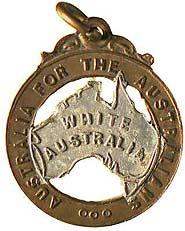
Australia for the 'Australians'

Like Seinfeld and Simpsons episodes, the culture wars arrive a decade late in Australia. Ten years after The Bell Curve set off a furore in the US, Sydney-based academic Andrew Fraser has seized on research linking race, IQ and socioeconomic outcomes to support his claims that Anglo-Celtic society is under siege from dumb blacks and smart Asians.

The fact that Fraser happens to be a law professor at Macquarie University, which has offered to buy out his contract and banned him from teaching in lecture rooms (though not from the campus grounds), has raised issues not only of freedom of speech but of academic freedom at our universities. The allegedly Trotskyite media has helped Fraser cast himself as an informed dissenter being persecuted by minority lobby groups and a left-wing establishment. Macquarie VC Di Yerbury says that the teaching ban reflected safety concerns expressed by Fraser himself, particularly in view of threats by far right groups to converge on the campus and enforce Fraser's right to preach kulturkampf from the pedestal of a Macquarie professorship. According to Fraser, racial attributes fall within his 'area of expertise' as a constitutional lawyer, thus entitling him to market his views under the university's name.

Given Fraser's adoption as the intellectual poster-boy of white supremacist groups like the Patriotic Youth League - to which he apparently gives pro bono legal advice - one wonders if this is a case of serious policy debate or of blinkered tribalism. Best to go straight to the horse's mouth. Take this extract from Fraser's interview on A Current Affair:

Andrew Fraser: It seems to me the basic goal of any immigration policy, if immigrants you must have, is to get people who are basically of the same ethnic stock of the people who are already present.

Ray Martin: What is a typical Australian in your eyes?

Andrew Fraser: It is the sun bronzed, blonde, blue eyed Aussie. That is what brought me down here. That is what, I would say, brought many people down here, the belief that what was really attractive about Australia, was that it was populated by Australians.


They must be short of blonde, blue-eyed people in Canada (whence the good professor hails). Or maybe just of bronzed ones. Consider this excerpt from Fraser's email correspondence with overseas law schools, quoted in the July 20 Parramatta Sun, the local paper which published Fraser's original article:

"Already the legal order is radically skewed against the interests of white men; that tendency will grow more pronounced as the managerial-professional elite becomes more heavily Asian.”

It's possible for a judiciary and legal profession that remain 90% white male and self-regulating to have overly progressive attitudes, but until I see some evidence for this I'll regard the proposition as bunk. Or more specifically as knee-jerk conspiracy theory masquerading as academic discourse, which is the crux of this whole affair.

"[My] argument is that the white Australia policy was fundamentally sound and that it was a mistake to abandon it ... [I am the victim of] the illegitimate demands of ethnic pressure groups and political extremists".

Migrant assimilation, the political influence of minority groups and ideological agendas in our educational institutions are clearly issues of community concern and legitimate topics for debate. It's sad that an educated man like Fraser can only express them through a dated social darwinist prism that turns disempowered groups into community bogeys. This transmutation of underdog into oppressor is a phenomenon that seems pronounced in, if not unique to, Protestant settler societies - the US South, South Africa, colonial (and, apparently, parts of 21stC) Australia. One theory concerns the evolution of a Persecuting Society in medieval Europe and its transplantation into the New World through a perverse transfer of oppression syndrome; but that's a topic for another post.

Fraser claims to be the victim of left-wing ideologues who control our technocratic elites. In fact he is himself propagating an ideology, one with identifiable and depressingly recurrent features. Take the projection of mainstream social vices - 'a culture of tribalism and violence', to quote PYL spokesman Luke Connors - onto powerless minorities, in this case Sudanese refugees. Then there's the spectre of domination by any disproportionately successful migrant group ('Asians', whatever that term means). And don't forget the motif
of inviolable white womanhood - the 'world's most endangered species', according to material being distributed by the White Pride Coalition in Toowoomba (Qld), a town where my Malaysian aunt was recently denied service in a milkbar. All of these are features of a warped worldview that Australia has been trying to ditch since the 1970's but which evidently has deep roots in the Anglo-Celtic society that Fraser champions. The Hanson affair of the mid-90's was in retrospect only the outrunner of a battle for Australia's national soul, of the sort that has been raging throughout political and academic forums in the US for four decades. Asylum seeker wedge politics, the War on Islamic Terror, anti-Indonesian hysteria over Schapelle Corby's trial - multiculturalism isn't launching into the new century off the best foot.

Given that Fraser's contract with Macquarie has only a year left to run he'll hopefully decide to wrap this up as quickly and quietly as possible, treating it as an unpleasant prelude to a comfortable retirement. Since he's so keen on sun-bronzed Australians, perhaps he'll head north above our own mason-dixon line (a.k.a the Qld-NSW border), where the silent majority seem to share his views.